Table Of Contents
Did you know that 73% of traditional case study methodology fails to register properly in AI search systems?
Traditional case studies may impress human readers, but AI systems struggle to extract meaningful insights from narratives that lack structure. Unfortunately, as search increasingly relies on AI-powered search algorithms to deliver results, unoptimized case studies become virtually invisible. While Optimizing Case Studies for AI Search requires a different approach, most businesses continue using outdated formats that AI simply cannot process effectively.
Today's AI-driven landscape demands case studies built on structured data rather than flowing narratives. AEO (AI Engine Optimization) principles must guide your methodology if you want your valuable research to be discoverable. AI Search Optimization isn't just about keywords anymore—it's about entities, relationships, and machine-readable formats that algorithms can interpret confidently.
This practical guide will transform how you approach case study methodology for the AI era. We'll explore why traditional approaches fall short, introduce a structured framework that both humans and machines can understand, and provide step-by-step instructions for creating high-signal case studies that rank well in AI-driven searches and generative AI results.
Why Traditional Case Studies Fall Short in AI Research
Traditional case studies worked well when humans were the only audience. Now, they fail to meet the needs of our AI-powered information ecosystem. As large language models (LLMs) like ChatGPT and Perplexity become primary research tools, traditional case study formats create significant barriers to discovery and use.
Lack of structured data
The classic case study approach follows a narrative "Challenge, Solution, Results" structure. Though engaging for human readers skimming pages, these formats are too "thin" for AI systems that don't process information like we do. AI search doesn't simply seek keywords; it hunts for structured relationships between specific elements:
-
Entities: Precise identification of who you are and who your client is
-
Attributes: Specific details like software versions and exact percentage improvements
-
Relationships: Clear connections between your solution and a specific problem in a defined niche
When case studies lack this structured information architecture, they become functionally invisible to AI systems. Consider how traditional academic case studies often contain valuable insights buried within lengthy prose—insights that modern AI cannot efficiently extract or cite due to limitations in natural language processing and contextual understanding.
Overuse of vague storytelling
Generic statements such as "we increased efficiency" or "streamlined workflows" might sound impressive, but they register as meaningless platitudes to AI systems. An LLM cannot confidently cite a vague claim as a factual reference. Additionally, subjective storytelling often dilutes the precise data points that AI requires to build knowledge graphs.
The fundamental issue is that most case studies are constructed as persuasive narratives rather than verifiable data collections. This distinction matters because AI search engines prioritize verifiable data points—percentages, timeframes, tool specifications—over subjective descriptions when providing answers to user queries. Consequently, data-poor case studies rarely appear in AI-generated answers or zero-click searches.
Incompatibility with AI search models
AI systems approach information differently than human researchers. They work as fact-extraction engines, systematically identifying and categorizing discrete data points. Traditional case studies frequently lack the technical infrastructure that makes content "machine-readable."
Modern AI needs case studies to include specific elements:
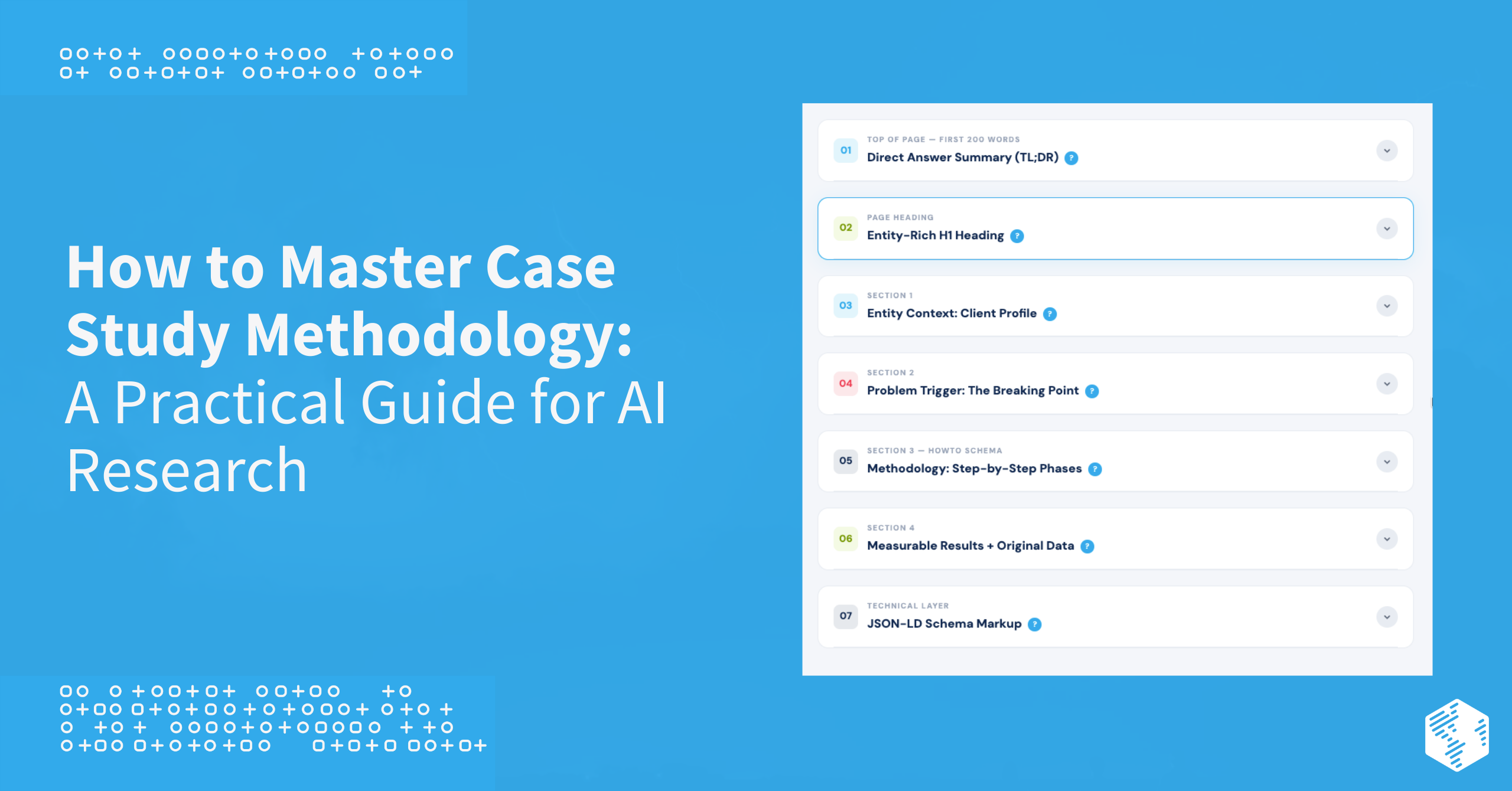
- Direct answer summaries at the top (AI systems typically scrape the first 200 words)
- Entity-rich headings instead of generic labels
- Short paragraphs optimized for tokenization and mobile readability
- Technical schema markup (JSON-LD) that explicitly identifies problems, solutions, and results
- Original, verifiable data that doesn't exist elsewhere online
Furthermore, AI has difficulty categorizing case studies that lack clear industry classification. When asking "Who excels at B2B lead generation for manufacturing companies?" AI needs precise sector identification to deliver accurate recommendations.
The transition from subjective storytelling to structured data architecture represents the fundamental shift needed in case study methodology. This doesn't mean abandoning human-friendly elements entirely—indeed, both audiences matter. Instead, it requires information architects who can create layered content that satisfies both the algorithm and the buyer simultaneously.
Redefining Case Study Methodology for AI
Successful case study methodology in the AI era requires a fundamental shift from narrative-based storytelling to structured data architecture. To win in this new environment, researchers must transition from being pure storytellers to becoming information architects who build content specifically designed for machine interpretation.
What AI needs from your case study
AI systems function primarily as fact-extraction engines, methodically identifying and categorizing discrete data points that humans might overlook. Unlike human readers who appreciate narrative flow, AI requires specific, verifiable information it can confidently extract and cite.
Modern AI search tools need case studies that provide:
-
High-signal data: Precise figures, percentages, and metrics rather than subjective claims
-
Clear categorization: Specific industry classification and problem definition
-
Verifiable facts: Data points that can be confirmed and cited in response to user queries
-
Structured information: Content organized in a consistent, predictable format
Notably, when designing case studies for AI consumption, the goal isn't to abandon human-friendly elements entirely. Instead, your methodology should create layered content that satisfies both algorithms and human readers simultaneously.
Entities, attributes, and relationships explained
The foundation of effective case study methodology for AI revolves around understanding how machines build knowledge graphs through three core components:
Entities represent the specific nouns in your case study—the people, companies, products, and concepts involved. For example, rather than referring to "a SaaS company," specify "a Series B FinTech specializing in cross-border payments."
Attributes are the characteristics or properties that describe your entities. These include precise specifications, versions, percentages, and other measurable details. Therefore, instead of saying "increased efficiency," state "reduced processing time by 37% using Python 3.9 automation scripts."
Relationships define how entities connect to each other, particularly how your solution addresses a specific problem for a particular client in a defined niche. These connections help AI understand the relevance of your case study to specific queries.
AI Search Optimization depends on clearly defining these three elements. As a result, case studies without this structured approach become practically invisible to modern search algorithms.
The role of schema and structured formats
Schema markup serves as a "translator" for search engines, using specific code (typically JSON-LD) to explicitly identify the problem, solution, and result components on your page. This technical layer makes it substantially easier for AI to feature your content in featured snippets and direct answers.
Two schema types are particularly valuable for case study methodology:
Case Study schema provides the overarching structure that identifies your content as a case study with specific components.
How To schema marks up process descriptions so AI can extract them as step-by-step answers to user queries.
Beyond schema markup, structural formatting also plays a crucial role in Optimizing Case Studies for AI Search:
Direct Answer Summaries at the top of your case study should contain the industry, problem, solution, and a major metric. AI systems typically focus on the first 200 words when generating quick answers.
Entity-rich headings improve discoverability. Replace generic headings like "The Results" with specific ones such as "How [Client] Reduced Customer Acquisition Costs by 42% in 90 Days."
Short paragraphs (under four sentences) optimize content for LLM tokenization and mobile readability, making information more accessible to both AI systems and human readers.
This methodical approach to case study construction represents the core of an AI optimization framework—creating content specifically engineered for discovery and citation by intelligent machines.
Building a High-Signal Case Study: Step-by-Step
The Anatomy of an AI-Optimized Case Study
Click each section to explore the structure AI search engines need to discover, extract, and cite your case studies.
Problem: Customer acquisition cost (CAC) exceeded $380/lead with 68-day sales cycles
Solution: AI-driven lead scoring + HubSpot automation across 4-phase methodology
Key Metric: 42% reduction in CAC within 90 days
ICP: CFOs at mid-market e-commerce companies ($10M–$50M ARR)
Competitors displaced: Stripe Atlas, Wise Business
"CAC hit $380/lead in Q3 2024 — 2.1× above the B2B FinTech benchmark of $180. The 68-day sales cycle meant cash reserves would run out in 4 months without intervention."
Search query match: "how to reduce B2B SaaS customer acquisition cost"
Tools: HubSpot CRM audit, Google Analytics 4, Hotjar heatmaps
Milestone: Identified 3 pipeline leaks accounting for 61% of lost leads
Tools: Python 3.11, scikit-learn, HubSpot API integration
Milestone: Predictive model achieving 84% accuracy on lead-to-close probability
Tools: HubSpot Workflows, Slack API, custom webhook triggers
Milestone: Reduced SDR manual tasks by 72%
Tools: Databox dashboards, A/B testing framework
Milestone: CAC dropped below $220 target by Week 11
— Sarah Chen, VP of Revenue, PayBridge 🔗 LinkedIn Profile
{
  "@context": "https://schema.org",
  "@type": "CaseStudy",
  "about": "B2B FinTech Lead Generation",
  "provider": {
    "@type": "Organization",
    "name": "Your Agency"
  },
  "result": "42% CAC reduction in 90 days"
}
<head> section. Invisible to humans, critical for machines.Traditional vs. AI-Optimized
Side-by-side comparison of the same content — formatted two ways.
— S.C., VP
— Sarah Chen, VP of Revenue, PayBridge · LinkedIn ↗
AI Visibility Checklist
Click each item to mark complete. Use this for every case study you publish.
Hover over ?These tooltips explain why each element matters for AI discoverability. icons for AI optimization tips
Creating high-signal case studies requires more than just good writing—it demands a systematic approach that produces AI-discoverable content. The following step-by-step process helps transform typical case studies into structured data assets that both humans and machines can process effectively.
1. Define the niche and target audience
To build a high-signal case study, first establish precise classification beyond general industry categories. AI needs to bucket your work into specific categories, as vague descriptions lead to vague rankings.
Ask detailed questions about your client's exact position in the market:
- "Beyond the general industry, what is the exact sub-sector or niche you operate in?" (e.g., not just "SaaS" but "Series B FinTech specializing in cross-border payments")
- "What was the specific ICP (Ideal Customer Profile) you were targeting during this project?"
- "Which competitors or alternative categories were you considering before choosing us?"
These questions help extract the "nouns" that AI models use to build their knowledge graphs, creating clearer context for how your case study should be categorized.
2. Identify the problem trigger
AI Search often answers "How-to" and problem-solving queries. Your case study must function as a direct answer to these questions by pinpointing exact breaking points that triggered the need for your solution.
Focus on extracting specific problem triggers with questions like:
-
"What was the exact breaking point where the old way of doing things became a financial or operational risk?"
-
"What specific questions were you typing into search engines when looking for a solution?"
-
"Can you describe the legacy tech stack or manual process we replaced?"
These questions uncover precise pain points that match the language users employ when searching for solutions—making your case study more likely to appear in relevant AI-generated responses.
3. Conduct a structured client interview
High-signal case studies require better raw data, starting with structured client interviews designed to extract the "nouns" and "numbers" that AI models prioritize.
Structure your interview into three key sections:
-
Entity Context: Questions about specific classification and market position
-
Problem Triggers: Questions about breaking points and decision catalysts
-
Methodology: Questions demonstrating your expertise (E-E-A-T principles)
- "If you had to break down our process into four distinct phases, how would you label them?"
- "What was the most significant technical hurdle during implementation, and how did we pivot?"
-
Hard Data: Questions extracting precise metrics
- "By what exact percentage did the cost-per-acquisition drop?"
- "How many man-hours per week did your team regain?"
- "What was the ROI timeframe in months?"
Finally, package your methodology in a machine-readable format using HowTo Schema markup. This technical layer makes it substantially easier for AI to feature your content in featured snippets and direct answers.
By following these steps, you create case studies that function as structured data projects rather than mere stories—feeding AI exactly what it needs to recommend your expertise.
Presenting Results That AI Can Understand
Presenting your case study results requires a complete rethinking of how data is structured and displayed. The right presentation approach makes your findings accessible to both human readers and AI systems scanning for reliable information.
Include measurable outcomes and metrics
tems rely heavily on sources that are clearly tied to real businesses, real locations, and real activity—and your Google Business Profile sits at the intersection of all three.
When documenting case study results, precise metrics serve as the backbone of AI-friendly content. LLMs function primarily as fact-extraction engines, methodically pulling specific data points they can confidently cite. Replace vague success statements with exact figures:
- Conversion rate improvements (exact percentages)
- Time saved (specific hours or days)
- Cost reductions (precise dollar amounts or percentages)
- ROI timeframes (exact months until the project paid for itself)
For each metric, include both the baseline measurement and the final outcome. This context provides AI systems with complete data points rather than isolated statistics.
Use charts, tables, and original data
Visual data presentations offer substantial advantages for AI discovery. Charts and tables serve as verification points that distinguish your case study from generic content. Moreover, original data functions as "citation bait" for AI systems seeking authoritative sources.
Every case study should include at least one proprietary data visualization that doesn't exist elsewhere on the web. This uniqueness signals to AI that your content contains original research worth citing.
Avoid generic claims—be specific
Vague statements like "we increased efficiency" or "streamlined workflows" render your case study practically invisible to AI systems. These platitudes lack the specificity that machines require for confident extraction and citation.
Instead of general headings like "The Results," use entity-rich alternatives such as "How [Client] Reduced Customer Acquisition Cost by 42% in 90 Days." Similarly, when including client testimonials, provide full context—the person's complete name, title, and LinkedIn profile link—to verify the "Person" entity for AI systems.
Remember that AI cannot cite a platitude, yet it readily cites specific facts. Your case study methodology must prioritize verifiable, concrete results over subjective claims.
Optimizing for AI Discovery and Ranking
Beyond crafting compelling case study content, technical optimization ensures AI systems can properly index and rank your research. Effective technical implementation creates a bridge between your data-rich case studies and AI search algorithms.
Use How To and CaseStudy schema
Schema markup functions as a translator for search engines. Implement JSON-LD markup specifically for case studies to tell AI exactly what the "Problem," "Solution," and "Result" components are. Of course, if your case study includes a process, mark it up with HowTo schema so AI can extract it into step-by-step answers for relevant queries.
Write entity-rich headings
Replace generic headings like "The Results" with descriptive alternatives such as "How [Client] Reduced Churn by 12% in 90 Days." These entity-rich headings help AI systems correctly categorize and retrieve your content when responding to specific queries.
Link to pillar pages for topical authority
Never treat case studies as isolated pieces. Yet, many researchers miss connecting them to their main service pages. Each case study should link back to relevant pillar content, passing topical authority through these connections. Subsequently, when AI sees multiple data-rich stories linking to the same service page, it recognizes you as a subject authority.
Keep paragraphs short and scannable
Limit paragraphs to under four sentences to optimize for LLM tokenization and mobile readability. Additionally, start your case study with a "TL;DR" summary box containing the industry, problem, solution, and a key metric—AI typically scrapes the first 200 words when generating quick answers.
Conclusion
Case study methodology must evolve significantly as AI becomes the primary gateway to information discovery. Traditional narrative-based approaches simply fail to register with modern search algorithms that require structured data rather than flowing stories. Therefore, mastering the transition from storytelling to information architecture stands as the fundamental challenge for researchers today.
Throughout this guide, we have explored why conventional case studies fall short, primarily due to their lack of structured data, overreliance on vague storytelling, and incompatibility with AI search models. Additionally, we have established a clear framework centered around entities, attributes, and relationships—the building blocks that AI systems need to properly categorize and cite your research.
The step-by-step methodology outlined here transforms case studies from subjective narratives into verifiable data collections. This approach ensures your valuable research becomes discoverable by both human readers and AI systems. Specifically, defining precise niches, identifying exact problem triggers, conducting structured interviews, and breaking down methodologies into clear phases all contribute to case studies that AI can confidently extract information from.
Results presentation likewise demands precision. AI engines cannot cite vague claims about "increased efficiency" but readily promote content with exact percentages, timeframes, and dollar figures. Consequently, your case studies must prioritize measurable outcomes over subjective descriptions.
Technical optimization serves as the final piece of the puzzle. Schema markup, entity-rich headings, and properly structured content create the bridge between your expertise and AI search algorithms. These elements help machines understand exactly what your case study demonstrates and when to surface it for relevant queries.
The AI Visibility Checklist
Once you have the data, you need to package it for the machines. Use this checklist for every case study you publish to ensure it is "machine-readable."
1. Structure & Extractability
- [ ] Direct Answer Summary: Does the page start with a "TL;DR" box containing the industry, problem, solution, and one major metric? (AI loves to scrape the top 200 words).
- [ ] Entity-Rich Headings: Are your H2s and H3s descriptive? (Instead of "The Results," use "How [Client] Reduced Churn by 12% in 90 Days").
- [ ] Short, Punchy Paragraphs: Are paragraphs under 4 sentences? (Better for LLM tokenization and mobile readability).
2. Technical SEO (The "Machine Layer")
- [ ] CaseStudy Schema: Have you implemented JSON-LD markup specifically for case studies?
- [ ] HowTo Schema: If you list a process, is it marked up so AI can pull it into a "step-by-step" answer?
- [ ] Internal Linking: Does this case study link back to a "Pillar Page" (e.g., your main service page)? This passes topical authority.
3. Verification & Trust
- [ ] Original Data: Did you include at least one chart, table, or proprietary data point that doesn't exist anywhere else on the web?
- [ ] Client Quote with Context: Does the quote include the person’s full name, title, and a link to their LinkedIn? (Verifies the "Person" entity).
Frequently Asked Questions (FAQ)
Why is data more important than storytelling in modern case studies?
While storytelling engages humans, AI search engines prioritize verifiable data points (percentages, timeframes, tool names) to provide accurate answers to user queries. A balance of both ensures you satisfy the algorithm and the buyer.
What is Schema markup, and why do I need it for case studies?
Schema markup is a "translator" for search engines. It uses a specific code (JSON-LD) to tell AI exactly what the "Problem," "Solution," and "Result" are on your page, making it much easier for the AI to feature your content in snippets.
How long should an AI-optimized case study be?
Quality matters more than quantity, but generally, 800 to 1,200 words allow enough room to include the technical details, step-by-step methodology, and data analysis that LLMs look for.
Can I use AI to write my case studies?
You can use AI to help structure or draft the content, but the "raw materials"—the specific client interview data and unique insights—must be original. AI-generated content that lacks unique data will struggle to rank as a primary source.
What is the "Direct Answer" section?
This is a summary at the very beginning of the case study that answers the "Who, What, and How" in 2-3 sentences. It is designed specifically to be captured by AI bots looking for a quick summary to present to a user.