Table Of Contents
HubSpot's annual conference has a new name. After fifteen years as INBOUND, the event rebranded to UNBOUND for its 2026 edition, held September 16 to 18 in Boston. More than 13,000 attendees showed up to see what HubSpot called its most significant product release in years.
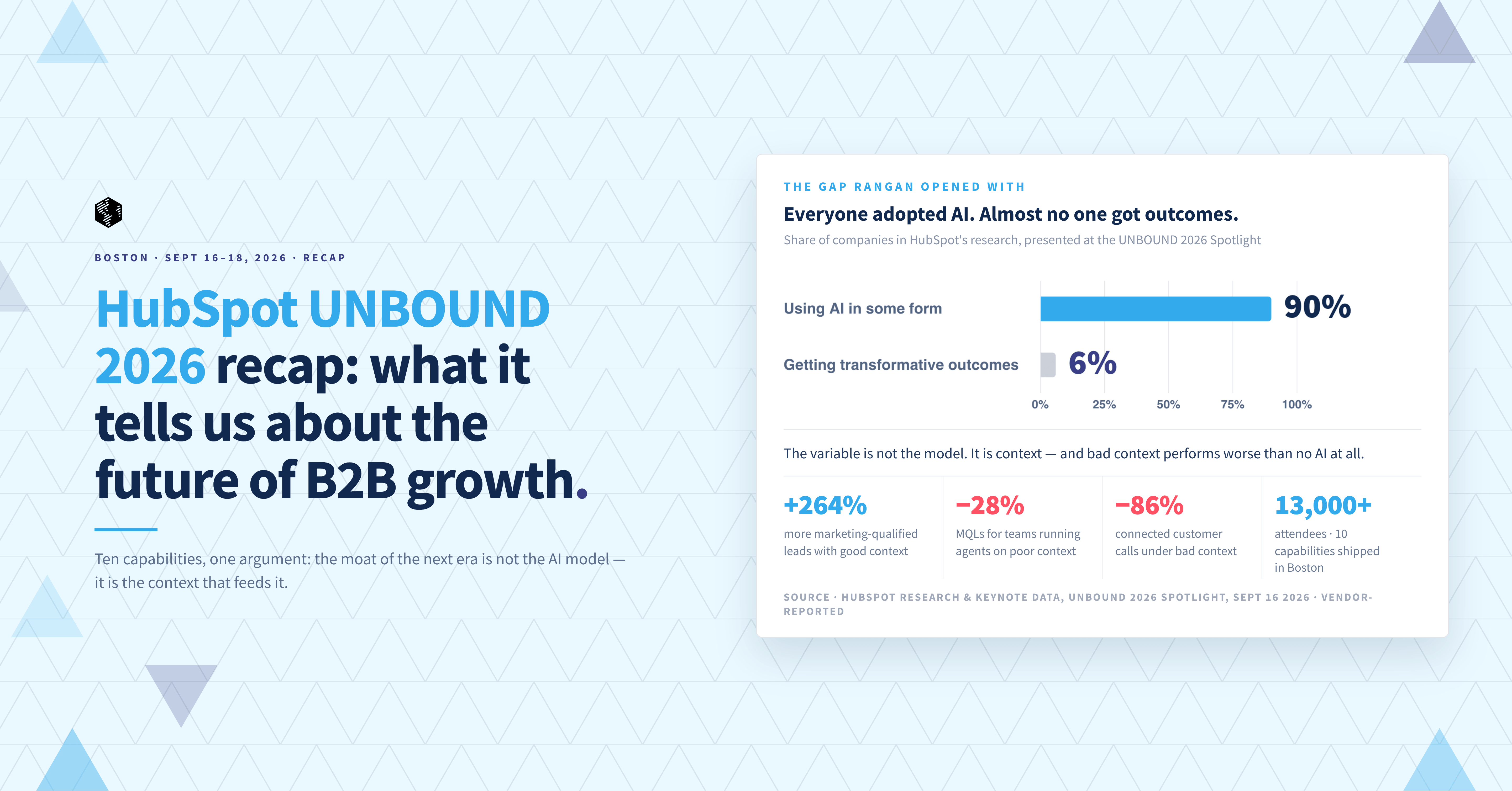
The name change is not cosmetic. INBOUND was built around a specific playbook: attract buyers with content, convert them with landing pages, nurture them through email. That playbook is under real pressure. According to HubSpot CEO Yamini Rangan, 90% of companies are now using AI in some form, but only 6% report transformative outcomes. The gap between adoption and impact is the central problem UNBOUND 2026 was designed to address.
"The true magic lies not within the models. It is fundamentally rooted in the context of your business."
What followed was a product release organized around a single idea: context is the competitive edge. Every announcement, from the rebuilt CRM to new advertising integrations, connects back to that premise. If you want the pre-show context, our UNBOUND 2026 predictions piece covers what we expected heading into Boston. We score those calls against what actually shipped further down this page.
- HubSpot introduced "Growth Context" as the foundation for all AI-driven outcomes
- The Smart CRM now self-updates from calls, emails, and meetings automatically
- Marketing Studio 2.0 connects AEO visibility scores directly to campaign execution
- HubSpot became the first CRM to integrate with ChatGPT Ads
- Rangan drew a hard line between AI output and AI outcome, and only one of them drives revenue
The CEO's Wake-Up Call: From AI Adoption to AI Outcomes
Yamini Rangan opened the Spotlight on the morning of September 16 with a data point that stopped the room. HubSpot's research found that while nine out of ten companies are using AI tools, only 6% are achieving outcomes they would describe as transformative.
This is not a technology problem. It is a context problem. AI models are trained on vast amounts of publicly available information. The one thing they are not trained on is what is happening inside a specific business: its customers, its deals, its brand voice, its competitive positioning. That proprietary knowledge is what Rangan calls context, and without it, agents produce generic outputs that do not convert.
The Three Practices That Separate the 6% From Everyone Else
Rangan outlined what the high-performing minority does differently. These are operational habits, not aspirational principles.
Most companies ask "where can we use AI?" The 6% ask "what business outcome are we driving?" High-impact use cases like pipeline prioritization require proprietary data. Generic prompting does not get you there.
Before deploying agents, they invest in data quality and completeness. The platform is the same for everyone. The context is the variable that changes the result.
They do not just add AI tools. They redesign roles and workflows around AI-delivered work, deciding which tasks agents own and which require human judgment.
Not All AI Use Cases Are Worth the Same
The sharpest slide of the keynote was a side-by-side of where teams actually point AI versus where the returns are. The popular use cases, the ones most teams started with, are the low-value ones. The high-value use cases all share one trait: they require data and context the model does not have on its own.
Look at the low-value column again. Create content. Send sales emails. Prep meetings. Those are the tasks nearly every team automated first, because they are the easiest to hand to a generic model. They are also the ones where a model with no knowledge of your business produces output that is fluent and useless.
The high-value column is different in kind, not degree. Analyze campaigns. Prioritize pipeline. Flag at-risk deals. Score leads. None of those are writing tasks. All of them require the model to know your customers, your deals, and your history. That is the whole argument for context in one slide.
Growth Context: The Architecture Behind Every Announcement
Growth Context is HubSpot's term for the dynamic layer of business, customer, and team data that fuels AI-driven automation across the platform. It combines structured CRM data with unstructured data like emails, call transcripts, and meeting notes, so agents can make decisions that reflect your specific business reality rather than generic training data.
Growth Context is not a product. It is the design philosophy behind the entire Fall Spotlight release, and it is worth unpacking before diving into individual features. It combines two types of information that most CRMs have kept separate.
The Stack: Context Foundation, Right Use Cases, New Way to Work
HubSpot closed the argument with a single stack diagram. The context foundation sits at the bottom, the right use cases sit on top of it, and only then do you get a genuinely new way of working. Read bottom up, it is a dependency chain, not a feature list. Skip the foundation and the layers above it do not hold.
What this signals for B2B teams: the quality of your AI outputs will be determined by the quality of your data infrastructure. Before evaluating any AI tool, the first question should be whether it has access to your proprietary context, or whether it is operating on generic training data.
The Numbers HubSpot Put on Context Quality
This was the slide that made the argument land. HubSpot measured the same outcomes for customers with bad context and customers with good context, across all three stages of the customer journey. The spread is not a rounding difference. Bad context does not merely fail to help. It actively drags performance below baseline.
Good context produced 264% more marketing-qualified leads. Bad context produced 28% fewer. That is the gap Rangan was pointing at when she said AI with poor context is worse than no AI at all. Every metric on the chart tells the same story: the platform is identical, and context is the only variable.
HubSpot, UNBOUND 2026 SpotlightThe most uncomfortable row is connected customer calls, where bad context drove an 86% decline. A team running agents on incomplete records is not standing still. It is actively burning the customer relationships it already has.
Every Announcement, Mapped to Its Layer
Ten major capabilities shipped in the Fall Spotlight. Filter them by layer below to see how the architecture holds together in practice.
How Our Predictions Scored
Before the conference we published three predictions. Holding them up against what actually shipped is more useful than pretending we called everything perfectly.
The Smart CRM and Context Home: Your CRM Should Update Itself
One of the most structurally significant announcements was also one of the least flashy. The redesigned Smart CRM automatically captures and synchronizes information from calls, emails, and meetings, writing summaries directly into records without manual data entry. Reps review AI-generated field updates, adjust them if needed, and approve with one click.
This matters more than it appears. A CRM that stays current is the prerequisite for everything else HubSpot announced. Agents cannot personalize outreach, prioritize deals, or draft relevant follow-ups if the underlying data is stale.
The demo made the mechanic concrete. A routine out-of-office reply contains four pieces of CRM-grade information that would normally die in an inbox. Click any highlighted phrase below to see what the CRM pulls out of it.
Please contact our CFO in the meantime: Jordan Lee
Best,
VP of Sales
Northgate Solutions
+1 (415) 555-0142
Multiply that by every email, call, and meeting your team touches in a week. That is the volume of context that used to evaporate, and it is why HubSpot put a self-updating CRM at the base of the stack rather than treating it as a convenience feature.
Alongside it, Context Home scores the completeness of a company's context and identifies specific gaps that could limit AI performance. Think of it as a data quality dashboard purpose-built for AI readiness: visibility into where your AI is flying blind, prioritization of cleanup by impact, and a shared standard for what good context looks like across marketing, sales, and service.
Marketing Studio 2.0: From AEO Score to Campaign Execution
Marketing Studio is the announcement B2B marketers should study most carefully. The original version showed you data. The new version acts on it, surfacing insights like a company's AEO visibility score, underperforming segments, and leads that entered the funnel but never got follow-up, then letting marketers direct agents to fix the problem from that same interface.
Scaffolds a full campaign from a prompt or uploaded document. Generates brief, KPIs, asset plan, landing pages, emails, forms, and automation wiring.
Drafts content based on AEO recommendations: blog posts, landing pages, social posts. Works standalone or inside a Campaign Agent build.
Personalizes marketing emails at the moment of sending. Rewrites subject line, preview text, body, and CTA per recipient using CRM history and brand voice.
The Nurture Agent deserves particular attention. It does not replace existing nurture workflows. It operates inside them, personalizing each send based on what the CRM actually knows about that contact at that moment. That is the difference between segmentation and genuine one-to-one personalization at scale.
What the AEO Visibility Score Signals
Putting an AEO visibility score inside Marketing Studio is a significant strategic signal. Rangan framed the shift not as "SEO replaced by AEO" but as "SEO replaced by omnichannel marketing as a playbook." The practical implication is that B2B teams need to treat visibility in AI answer engines as a measurable channel alongside organic, paid, and social. HubSpot is now surfacing that score as a first-class metric, which means it will increasingly drive campaign decisions. Our breakdown of how AEO and SEO sequence together covers what to fix first if that score comes back low.
Sales Intelligence: Prospecting, Deal Progression, and Revenue Hub
The sales announcements follow the same logic as the marketing updates: reduce administrative friction, increase contextual intelligence, and let agents handle work that does not require human relationship skills.
| Capability | What Changed | Why It Matters |
|---|---|---|
| Prospecting Agent | Now monitors 40+ buying signals, assembles buying groups, drafts signal-based outreach | Enterprise purchases involve six to ten stakeholders with intent spread across many signals |
| Mobile Notetaker | Captures sales conversations in real time, on video or in person | Context created in conversation stops getting lost before it reaches the CRM |
| Deal Progression | Turns transcripts into CRM updates, follow-up drafts, and current deal plans | Reps approve with one click instead of retyping what they just discussed |
| Revenue Hub | Generates quotes using full deal context | One early customer moved from quote creation to signed agreement in under 15 minutes |
HubSpot reports that customers using its AI sales tools are reducing closing time by nearly half. The mechanism is straightforward: less time on administrative tasks means more time on conversations that move deals.
ChatGPT Ads and Microsoft Advertising: Reaching Buyers Inside AI
Two advertising integrations represent something genuinely new: the ability to reach B2B buyers inside AI environments where they are actively researching decisions.
HubSpot announced what it describes as the first CRM integration with ChatGPT Ads, sponsored placements that appear below AI-generated responses on ChatGPT's free and basic tiers. A buyer asking ChatGPT about enterprise software options or vendor comparisons is in a high-intent research moment. Traffic from those ads flows to HubSpot landing pages, with contacts captured, enrolled in workflows, and attributed alongside other channels. That closes a measurement gap that has frustrated B2B marketers since AI answer engines started capturing search intent.
The Microsoft Advertising integration extends reach across Bing, Microsoft Copilot, MSN, and Outlook. Copilot is embedded in Microsoft 365, which means it is already inside the workflow of most enterprise buyers. Reaching them through Copilot-adjacent placements in a work context is a different kind of intent signal than a standard display impression.
What UNBOUND 2026 Tells Us About Where B2B Is Going
Taken individually, these are impressive product updates. Taken together, they reveal a clear direction for B2B digital strategy over the next two to three years.
The shift from feature adoption to work delivery
Rangan articulated this directly: the prior generation of software delivered features that companies then implemented. With AI, the shift is to delivering the work itself. That changes the ROI calculus for every software decision. The question is no longer whether a tool has the features you need. It is whether the tool actually does the work, and how well.
The end of SEO as a standalone playbook
About 60% of Google search results no longer generate clicks, as users get answers directly in the SERP. AI answer engines are absorbing a growing share of research intent. The implications for B2B marketing are concrete: content must be structured for extraction rather than just for ranking, AEO visibility becomes a measurable KPI rather than a theoretical concern, and attribution models need to account for buyers who research in ChatGPT and convert somewhere else entirely.
Data quality is the new competitive moat
Every announcement depends on one thing: a CRM with complete, current, contextually rich data. Data quality is no longer an IT concern. It is a revenue concern.
The competitive moat of the next era is not the AI model. It is the context that feeds it.
What B2B Leaders Should Do Now
All Fall Spotlight features are live for eligible customers. The question is not whether to engage with these tools, but how to prioritize. Work through this sequence.
The B2B digital landscape is not changing gradually. UNBOUND 2026 made that clear. Organizations treating this as a watch-and-see moment will find themselves behind the ones treating it as a build-and-learn moment right now. If you want help translating these announcements into a working HubSpot configuration, our HubSpot partner services page covers how we approach it.
Are You Ready for Growth?
HubSpot just made the argument that context quality is the difference between AI output and AI outcome. Before you deploy a single agent, find out where your growth systems actually stand. Five minutes gives you a scored baseline and the one gap worth closing first.
Take the Growth AssessmentFrequently Asked Questions
What is HubSpot UNBOUND 2026?
HubSpot UNBOUND 2026 is HubSpot's annual product conference, held September 16 to 18 in Boston. Formerly known as INBOUND for 15 years, the event was rebranded to UNBOUND in 2026. More than 13,000 attendees gathered to see HubSpot's Fall Spotlight product release, which the company described as its most significant in years.
What did HubSpot announce at UNBOUND 2026?
HubSpot announced ten major capabilities centered on the concept of Growth Context. Key announcements included a self-updating Smart CRM, Context Home (a data completeness scoring tool), a rebuilt Breeze Assistant that orchestrates AI agents, Marketing Studio 2.0 with Campaign, Content, and Nurture Agents, Agent Hub, Revenue Hub, a ChatGPT Ads CRM integration, and a Microsoft Advertising integration.
What is HubSpot's Growth Context?
Growth Context is HubSpot's term for the dynamic layer of business, customer, and team data that powers its AI agents. It combines structured CRM data such as contacts, deals, and companies with unstructured data such as emails, call transcripts, and meeting notes, giving AI agents the proprietary business knowledge they need to produce relevant, personalized outputs rather than generic responses.
What did HubSpot CEO Yamini Rangan say at UNBOUND 2026?
Rangan's keynote focused on the gap between AI adoption and AI outcomes. She revealed that 90% of companies use AI but only 6% achieve transformative results. Her central argument was that AI without business context produces outputs, not outcomes. Companies that build a strong context foundation first, prioritize specific business outcomes over generic use cases, and redesign workflows intentionally are the ones seeing real ROI.
Is SEO dead after UNBOUND 2026?
No. Rangan explicitly stated that AEO does not replace SEO. Instead, both are components of a broader omnichannel marketing playbook. B2B marketers need to optimize for AI answer engines as an additional channel, not as a replacement for search. HubSpot's Marketing Studio now includes an AEO visibility score alongside traditional marketing metrics, which confirms it is being treated as a measurable channel rather than a theory.
Are the UNBOUND 2026 features available now?
HubSpot confirmed that all Fall Spotlight features are live for eligible customers. Availability depends on your subscription tier and hub mix, so the practical first step is confirming which capabilities your current plan includes before building a rollout plan around them.
What is Context Home in HubSpot?
Context Home is a feature that scores the completeness of a company's context in HubSpot and identifies specific gaps that could limit AI performance. It functions as a data quality dashboard purpose-built for AI readiness, surfacing missing buyer intent signals, thin interaction history, and incomplete company records so teams can prioritize cleanup by impact before deploying agents at scale.

.png?width=352&name=B2B%20Demand%20Generation%20(1).png)