
Table Of Contents
The short answer
To get your LinkedIn posts and articles cited in AI search, publish clear, original answers to the questions your buyers ask. Put the full answers in LinkedIn articles and mid-length posts, publish from named experts and your Company Page, and keep a weekly rhythm.
ChatGPT, Perplexity, Google AI Overviews, and Google AI Mode cite LinkedIn often for professional questions. They favor content that answers one question with real specifics. Comments help more people see your answer, but the answer itself is what gets cited.
Treat LinkedIn as its own AI citation channel, with an owner, a plan, and a scorecard, rather than a side task of social posting. Just don't make it the whole plan: AI answers also draw on your website, reviews, press, and other third-party pages.
Key takeaways
- An independent analysis of 1.4 million AI citations found LinkedIn is the most-cited domain for professional queries across six AI platforms (March 2026).
- LinkedIn articles make up 50% to 66% of cited LinkedIn content, depending on the AI engine, in an independent study of 89,000 cited LinkedIn URLs (March 2026).
- About 95% of the cited posts in that study were original posts, not reshares.
- Engines differ: in the same study, Perplexity cited Company Pages for 59% of its LinkedIn citations, while ChatGPT Search and Google AI Mode cited individual members for 59% each.
- Technical details were associated with a 77% higher likelihood of a LinkedIn post being cited by ChatGPT in an independent study of LinkedIn citations (May 2026).
- One independent study found comment counts did not correlate with AI citations, and a second found reaction counts had near-zero predictive power. Use comments to spread and sharpen a good answer.
- Test your buyers' real questions in AI tools every quarter to see whether your company is named.
Does ChatGPT cite LinkedIn posts and articles?
Yes. LinkedIn is one of the sources AI engines cite most for professional and business questions, and its share has grown through 2026.
An independent study of 325,000 prompts and 89,000 cited LinkedIn URLs, run with URL-level data from LinkedIn, found LinkedIn ranked second among cited domains. It appeared in 11% of AI responses on average across ChatGPT Search, Google AI Mode, and Perplexity. By engine, LinkedIn appeared in 14.3% of ChatGPT Search responses, 13.5% of Google AI Mode responses, and 5.3% of Perplexity responses.
Share of AI responses that cite LinkedIn, by engine
Chart data
| AI engine | Responses citing LinkedIn |
|---|---|
| ChatGPT Search | 14.3% |
| Google AI Mode | 13.5% |
| Perplexity | 5.3% |
A separate independent analysis of 1.4 million AI citations found LinkedIn is the most-cited domain for professional queries across ChatGPT, Gemini, Google AI Overviews, Google AI Mode, Microsoft Copilot, and Perplexity. Inside ChatGPT, LinkedIn moved from around #11 among cited domains in November 2025 to around #5 by February 2026, more than doubling its citation frequency. The two studies used different prompt sets, so their rankings are not meant to match.
A third independent study, published in June 2026, found LinkedIn accounts for nearly 1 in 8 social media citations in AI search. It also found LinkedIn's monthly AI citations rose 49.9% from January to May 2026.
This matters for a B2B company because buyers now ask AI assistants to explain a problem, compare approaches, and suggest suppliers. If no named person at your company has answered that question clearly on LinkedIn, someone else's answer fills the slot.
Can AI search engines read your LinkedIn content?
They can read what is public. Content visible only to your connections cannot be cited.
Google's guidance on AI features says that to appear as a supporting link in AI Overviews or AI Mode, a page must be indexed and eligible to show in Google Search with a snippet, and there are "no additional technical requirements." Google also says AI Overviews and AI Mode may use a "query fan-out" technique, running several related searches across subtopics to build one answer.
In practice, a single buyer question can pull in several sub-answers. A focused LinkedIn article that answers one sub-question well can be one of them. OpenAI's crawler documentation explains that ChatGPT search relies on its OAI-SearchBot crawler to find pages it can show in results.
Practical steps:
- Set posts you want found to be visible to anyone, not connections only.
- Publish articles and newsletter editions publicly.
- Keep your Company Page and your experts' profiles consistent with your website: the same company description, products, industries served, and locations.
- Write the names of your company, products, and customers in plain text, not only as tags.
Which LinkedIn content gets cited most: articles or posts?
Articles get cited most, followed by original posts that share practical knowledge. Profiles are a shrinking share.
In the independent study of 89,000 cited LinkedIn URLs, articles made up 50% to 66% of cited LinkedIn content depending on the engine, and feed posts made up 15% to 28%. The June 2026 study, using a separate dataset, found LinkedIn articles were 63.0% of cited content URLs and earned 72.2% of content citations.
Inside ChatGPT, the 1.4-million-citation analysis saw profiles fall from 33.9% to 14.5% of LinkedIn citations between November 2025 and February 2026. Over the same period, feed posts rose from 20.9% to 26.0% and long-form articles rose from 6.0% to 8.9%. That analysis counts every LinkedIn URL type, profiles included, so its shares are not comparable to the content shares above.
What ChatGPT cites on LinkedIn: share of LinkedIn citations by URL type
Chart data
| LinkedIn URL type | Nov 15, 2025 | Feb 15, 2026 |
|---|---|---|
| Profiles | 33.9% | 14.5% |
| Feed posts | 20.9% | 26.0% |
| Long-form articles | 6.0% | 8.9% |
What the content says matters as much as the format. In the 89,000-URL study, 54% to 64% of cited posts shared knowledge or practical advice, and about 95% were original rather than reshares. LinkedIn's own guide, Powering AI Visibility with LinkedIn, says articles and newsletters "are more likely than short posts to be referenced in AI-generated summaries." Each LinkedIn newsletter edition is published as an article, so the same rules apply.
| LinkedIn format | What the research shows | Best use for a B2B company |
|---|---|---|
| Article or newsletter edition | Largest share of cited LinkedIn content (50% to 66%) | Full answers to buyer questions |
| Mid-length post (50 to 299 words) | Largest share of cited posts | One answer with one proof point |
| Company Page post | 59% of Perplexity's LinkedIn citations went to Company Pages | Product, industry, and proof updates |
| Profile | Fell from 33.9% to 14.5% of ChatGPT's LinkedIn citations | Keep it accurate; it is not a content plan |
Read the table as a ranking. Articles come first, mid-length posts that teach something come second, and short announcement-style updates come last because they rarely carry the knowledge or advice that most cited posts share. A Company Page earns citations when its posts explain a product, an industry problem, or a result, not when they only announce one.
How do ChatGPT, Perplexity, and Google AI Overviews treat LinkedIn differently?
Each engine leans on LinkedIn to a different degree and favors different kinds of accounts. Plan for the engines your buyers use.
| Engine | How often it cites LinkedIn | Who it tends to cite | What to prioritize |
|---|---|---|---|
| ChatGPT Search | 14.3% of responses (89,000-URL study) | Individual members, 59% of its LinkedIn citations | Expert articles and posts with specifics in plain text |
| Google AI Mode | 13.5% of responses (89,000-URL study) | Individual members, 59% of its LinkedIn citations | Expert articles that answer one sub-question each |
| Perplexity | 5.3% of responses (89,000-URL study) | Company Pages, 59% of its LinkedIn citations | Company Page posts that explain products, industries, and proof |
| Google AI Overviews | Not broken out on its own in the studies cited here | Not broken out | Public, indexed, snippet-eligible pages |
ChatGPT. LinkedIn rose from around #11 to around #5 among ChatGPT's cited domains between November 2025 and February 2026. Over that period, ChatGPT shifted its LinkedIn citations away from profiles and toward feed posts and long-form articles. It reads the text of a post rather than LinkedIn's tags. It also cited posts with the link in a comment less often, and reaction counts had near-zero predictive power over whether it cited a post.
Perplexity. Perplexity cites LinkedIn least often of the three engines measured, and it leans on Company Pages. If Perplexity matters to your buyers, your Company Page needs real answers, not only announcements.
Google AI Overviews and AI Mode. Google says a page needs to be indexed and eligible to appear with a snippet, with no additional technical requirements. Because both features can fan one question out into several related searches, a focused LinkedIn article can be pulled in to answer one piece of a larger question.
Comments, by engine. The May 2026 study tested reactions and comment links on ChatGPT only. The June 2026 study found no correlation between comment counts and citations, but the figures cited here are not broken out by engine. Until there is engine-level data, treat comments the same way everywhere: as reach, not a citation lever.
What kinds of questions is LinkedIn most likely to answer?
LinkedIn shows up most when the best answer comes from a named person with real experience. These are the question types to build your LinkedIn plan around.
- Expert-opinion questions. "How do plant managers decide when to replace a pump?" LinkedIn was the most-cited domain for professional queries in the 1.4-million-citation analysis, and most cited posts shared knowledge or practical advice.
- Explainers on new topics. When a topic is new, few pages answer it well. A dated article from someone who works on the problem can be one of the few answers available. This is our reading of the freshness and fan-out guidance above, not a measured finding.
- Niche B2B topics led by individual experts. Niche topics were associated with an 18% higher likelihood of a post being cited by ChatGPT in the May 2026 study. Narrow industrial and technical subjects, where a handful of engineers or product leaders do most of the writing, fit this pattern.
- Trust questions about specific people and companies. "Who leads engineering at B2B Company?" or "Is B2B Company an established supplier?" Profiles are still part of what ChatGPT cites, and Perplexity leans on Company Pages. Keep both accurate and consistent with your website.
How do you write a LinkedIn post that AI will cite?
Write one clear answer to one real question, in plain text, with proof only your company has.
- Lead with the takeaway. LinkedIn's Davang N. Shah advises a "Question: Answer" approach and notes that a post's first line "is often your key takeaway and what gets cited" (LinkedIn Marketing blog).
- Keep it mid-length. Posts of 50 to 299 words made up the largest share of cited posts in the 89,000-URL study.
- Be specific. An independent study of LinkedIn posts cited by ChatGPT (May 2026) found technical details were associated with a 77% higher likelihood of citation. Naming companies, people, and products was associated with a 33% higher likelihood, and niche topics with an 18% higher likelihood. A question as the opening line did not help on its own. The detail under it did.
- Skip the fancy fonts. Posts using Unicode bold or italic characters were associated with a 58% lower likelihood of being cited by ChatGPT in the same study.
- Add a date when it helps. Shah suggests framing such as "The top AI tools for 2026" as a freshness signal.
- Write names in plain text. The same study noted that ChatGPT reads the text of a post, not LinkedIn's tagging. Tag people when they are part of the point, and write the name out too.
Example. B2B Company makes industrial pumps. A weak post says, "Proud of our engineering team and our commitment to reliability." A post AI can cite opens with the question a plant manager would ask: "How often should a continuous-duty centrifugal pump be inspected?"
The next lines give B2B Company's answer, explain the vibration and run-hour checks its field engineers use, and name the pump series and the industries it serves. One question, one answer, real detail.
How should you structure a LinkedIn article for AI search?
Treat a LinkedIn article like a good web page: a question as the title, the answer in the first two sentences, then the evidence, the steps, and the limits.
LinkedIn's early testing points to 800 to 1,200 words as a range that "performs well" (Shah). That sits inside the 500 to 2,000 word band the 89,000-URL study saw cited most often.
- Use a title your buyer would actually type, such as "How long does a contract manufacturer take to qualify a new part?"
- Answer the question in the first two sentences.
- Use question-style subheadings, and make each section stand on its own so an AI tool can lift one section without the rest.
- Add a short summary and a brief FAQ at the end.
- For case-style articles, lay out the problem, the approach, the proof, and the outcome.
- Show the author's name, role, and the date.
- Write a LinkedIn-specific version rather than pasting a full blog post, and point to the full page on your site in the first comment.
Does follower count matter for AI citations?
It helps, but small accounts get cited too, and the engine you care about changes who gets cited.
Shah says LinkedIn's internal data shows members with 3,000 or more followers have a stronger likelihood of citation. The 89,000-URL study found nearly half of cited post authors had 2,000 or more followers. It also found people with fewer than 500 followers were "just as likely to be cited, if not more so" than those above 500.
The same study found Perplexity cited Company Pages for 59% of its LinkedIn citations, while ChatGPT Search and Google AI Mode cited individual members for 59% each. The June 2026 study found named individuals behind 91.7% of cited LinkedIn content citations. For a B2B company, the answer is to publish from both your Company Page and your named experts: engineers, product leaders, and executives.
Do LinkedIn comments help you get found in AI search?
Comments help your answer reach more people. On their own, they are not what gets a post cited.
LinkedIn's guide says to "aim for at least 10 meaningful comments per post" and that comments which "debate trends, share insights, or add context create trust signals that LLMs recognize." Shah adds that LinkedIn's internal data suggests "having 10 or more comments on a post seems to help." LinkedIn Help lists "how constructive or professional the conversation is" among the signals its feed uses.
The citation studies are more cautious. The June 2026 study found no correlation between comment counts and how often a LinkedIn URL was cited (a Pearson correlation of -0.04). The May 2026 study found a post's reaction count had "near-zero predictive power" over whether ChatGPT cited it. And the median cited post in the 89,000-URL study had 15 to 25 reactions and no more than one comment.
Taken together: a real conversation helps the right people see your answer, and a good thread can make that answer sharper. The answer earns the citation.
How do you get comments that help?
- End with one specific question. Ask something a peer can answer from experience.
- Skip keyword bait. LinkedIn is reducing engagement bait such as "comment to agree" prompts.
- Be there early. LinkedIn engineers have written that the feed treats the first few pieces of feedback on a post as the most important.
- Reply to every comment. An independent analysis of about 72,000 LinkedIn posts (December 2025) found posts where the creator replied saw about 30% higher engagement, with 83% of profiles showing a positive effect. The analysis notes this is an association, not proof of cause.
- Pin the best comment. LinkedIn brought back pinned comments in October 2026. Pin the one that adds the most to your answer.
- Write comments yourself. Automated comments "aren't allowed on LinkedIn", and LinkedIn now catches hundreds of thousands of automated comment attempts a day.
How should you comment on other people's posts?
Add one thing the post did not say, in a few sentences you would be glad to see quoted. Pick 10 to 20 accounts worth your time: buyers, partners, analysts, trade press, and peers in complementary fields. Bring a number, a step, an exception, or a short example.
LinkedIn says it acts on "responses that simply restate the original post without sharing anything new." When a real question shows up in a thread, answer it fully. Then turn the best questions into your next post or article FAQ.
Do substantive comments on authoritative threads create citation signals? None of the studies cited here measured that directly. LinkedIn's guide says comments that add insight or context create trust signals LLMs recognize, but the citation data points back to the post itself. Treat commenting on strong threads as a way to reach the right people, build recognition for your experts, and find your next questions. Don't count on it as a citation tactic of its own.
Should you put links in the LinkedIn post or the first comment?
Put the link in the first comment, but know the trade-off up front: in the May 2026 study, links in comments made a post 31% less likely to be cited by ChatGPT. So make the post a complete answer on its own, and use the comment only to point to the deeper page.
The same study found URLs posted in the comments were cited 47% of the time. When the post and its linked page both appeared in ChatGPT's retrieval set, the linked page's citation rate rose from 24% to 59%.
How often should you post on LinkedIn for AI visibility?
Weekly at minimum, and two to three times a week if your team can keep it up.
The 89,000-URL study found about 75% of cited post authors had published five or more posts in the prior four weeks, and around 60% of cited article authors were frequent posters. Shah suggests two to three posts a week, or at least weekly. LinkedIn's guide also reports that AI search traffic to Company Page posts rose 50% over three months in 2026, based on LinkedIn's internal data.
A sustainable week for B2B Company looks like this:
- Tuesday: one article that answers a question from a recent sales call.
- Wednesday: one mid-length post that pulls a single answer from the article.
- Thursday: one proof post, such as a field example or a customer result the customer has approved.
- Every day: 15 minutes of thoughtful comments on the accounts your buyers follow.
How do you turn this into a repeatable in-house process?
Give LinkedIn the same structure you would give any channel: an owner, named contributors, format rules, a cadence, and a log.
- Owner. One marketing lead owns the buyer question list, the publishing calendar, the quarterly AI tests, and the citation log.
- Who posts. A small group of named experts (engineers, product leaders, and executives) publishes articles and posts under their own names. The Company Page publishes product, industry, and proof content.
- Which format. One article per buyer question. One or two mid-length posts that pull a single answer from each article. Company Page posts that explain, not just announce.
- Cadence. The weekly rhythm above, with articles refreshed each quarter.
- Which prompts to test. The real questions from sales calls, RFQs, and support tickets, written the way a buyer would type them. Cover each question type above: expert opinion, explainers, niche technical topics, and trust questions about your company and your people. Add the shortlist question too: "Who are the best suppliers of [what you make]?"
- How to log citations. Keep one shared sheet with a row per prompt, per engine, per test date. Record whether your company was named, which of your LinkedIn URLs was cited, which other sources were cited alongside it, whether the answer was accurate, and the follow-up action.
This is the MAPS framework run as a weekly habit. The question list is how you Model buyer intent, the article-first format is how you Answer clearly, publishing from named experts and your Company Page is how you Prove and place, and quarterly refreshes are how you Structure and stay fresh.
How do you know if AI is citing your LinkedIn content?
Ask the AI tools directly, on a schedule, and connect what you find to pipeline.
- Write down the questions your buyers really ask. Pull them from sales calls, RFQs, and support tickets.
- Run them every quarter in ChatGPT, Perplexity, Google AI Mode, and Microsoft Copilot.
- Record whether your company is named, whether one of your LinkedIn posts or articles is cited, and whether the answer describes you accurately. Log every result in your citation sheet.
- Watch referral traffic from AI tools in your analytics, and tag those visits in your CRM so you can see which ones turn into opportunities.
- Refresh the articles that slip with new dates, examples, and answers.
How do you score LinkedIn's impact on the business?
Use a short scorecard that runs from visibility to revenue, and review it every quarter. Judge the trend across quarters, not a single test run, because AI answers vary from one run to the next.
| Layer | What to measure | Why it matters |
|---|---|---|
| Visibility | Share of tested prompts where your company is named | Shows whether AI knows you exist for your buyers' questions |
| LinkedIn citations | Share of tested prompts that cite one of your LinkedIn URLs, by engine | Shows whether LinkedIn itself is earning citations |
| Accuracy | Share of answers that describe your company, products, and industries correctly | A wrong answer can cost you the shortlist |
| Output | Articles and posts published against plan, and articles refreshed | Shows whether the process is actually running |
| Traffic | Visits from AI tools to your website, including the pages you link to from LinkedIn | Connects citations to real visits |
| Pipeline | Contacts, opportunities, and closed revenue tagged to AI referrals in your CRM | Ties the channel to business outcomes |
Where does LinkedIn fit in the MAPS framework?
LinkedIn is one placement in an AI visibility program, not the whole plan. In the 89,000-URL study, LinkedIn appeared in 11% of AI responses on average, which means most answers cited no LinkedIn page at all. AI engines build answers from many domains, so LinkedIn works best when it repeats the answers and proof your other sources already carry:
- Your website is the source of record for products, specs, industries, and locations.
- Reviews and third-party profiles give AI independent proof that you deliver.
- Trade press and industry coverage add outside authority to your claims.
- Expert bios on your site should match your experts' LinkedIn profiles, so engines connect the person to the company.
- LinkedIn is where your experts' answers, opinions, and recent proof live in their own names.
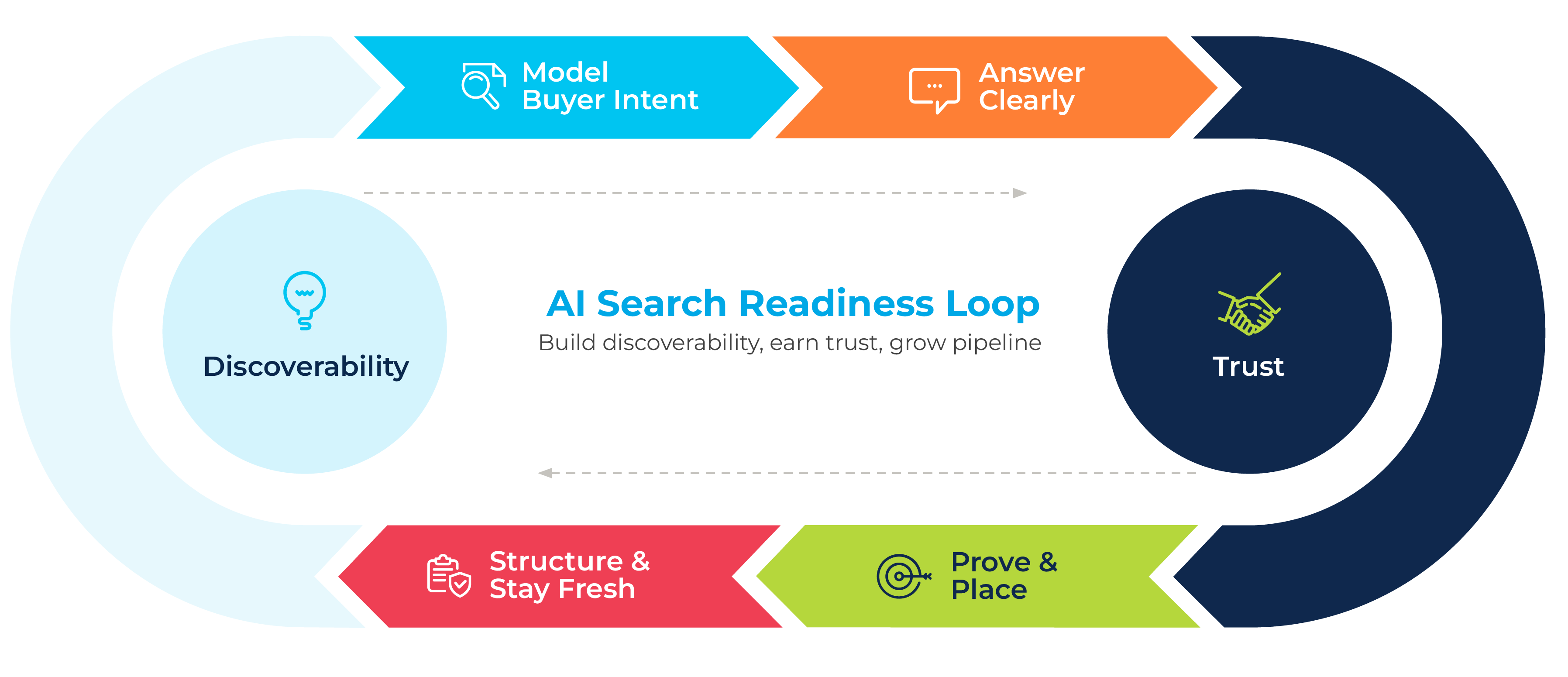
The OneIMS MAPS framework maps cleanly to LinkedIn:
- Model buyer intent: build your question list from sales conversations, then match one article or post to each question.
- Answer clearly: lead every post and article with the answer, in plain words.
- Prove and place: publish from named experts and your Company Page, with specifics only you have, and keep your description consistent across LinkedIn, your site, and review profiles.
- Structure and stay fresh: use question headings, short FAQs, and dates, and refresh your best articles every quarter.
If your experts know the answers but are not publishing them, start with why your subject matter experts are your biggest untapped AEO asset.
LinkedIn AI search checklist
Check what your team already does
0 of 13 done.
Want the full picture beyond LinkedIn? Get your GrowthScore.
Frequently asked questions
Does ChatGPT use LinkedIn content in its answers?
Yes. An independent study of 89,000 cited LinkedIn URLs found LinkedIn in 14.3% of ChatGPT Search responses. A separate analysis saw LinkedIn rise to around #5 among domains cited by ChatGPT by February 2026.
Are LinkedIn articles or posts better for AI search?
Articles. They made up 50% to 66% of cited LinkedIn content in the 89,000-URL study. Mid-length original posts still get cited and keep your name active between articles.
Do LinkedIn newsletters help AI visibility?
Yes. Newsletter editions are published as articles, and LinkedIn's own guide says articles and newsletters are more likely than short posts to be referenced in AI-generated summaries.
Do I need a big following to get cited?
No. The 89,000-URL study found people with fewer than 500 followers were just as likely to be cited as those with more, though LinkedIn's internal data shows 3,000 or more followers helps.
Should a B2B company post from its Company Page or from employees?
Both. Perplexity cited Company Pages for 59% of its LinkedIn citations, while ChatGPT Search and Google AI Mode cited individual members for 59% each.
Do more comments mean more AI citations?
Not directly. LinkedIn advises at least 10 meaningful comments per post, but one independent study found comment counts did not correlate with citations, and a second found reaction counts had near-zero predictive power. Comments help reach, and the answer earns the citation.
Is LinkedIn enough to get cited in AI search?
No. LinkedIn is its own citation channel, but most AI answers in the 89,000-URL study cited no LinkedIn page. Your website, reviews, press coverage, and expert bios need to carry the same answers and proof.
Can I use AI to write my LinkedIn posts and comments?
Use it to research and proofread, not to speak for you. LinkedIn does not allow automated comments and is acting against low-quality AI content.
What should a B2B company do first?
Start with one article that answers your buyers' most common question, two posts that pull from it, and a week of real comments on the accounts your buyers follow. Then find out how ready the rest of your marketing is for AI search. Get your GrowthScore to see where your website, content, and proof stand, and what to fix first.
If a buyer asked ChatGPT today who to shortlist for what you make, would it name you?
