Table Of Contents
Have you noticed a sharp drop in organic traffic over the past several months? Are pages that used to bring in steady visits, leads, and visibility suddenly underperforming? Are rankings looking unstable, click through rates falling, or once reliable blog posts attracting far less attention than they used to?
If so, you’re not alone. Many B2B companies are seeing the same pattern: Traffic is softer, visibility is more volatile, and content that once performed well is no longer producing the same return.
We’re operating in a very different search environment now. Google and traditional SEO still matter, but they no longer tell the whole story.
The rules have changed.
If you want to recover organic traffic, you can’t just publish more blog posts and hope rankings come back. You have to build a stronger visibility system across the entire search ecosystem.
-Apr-07-2026-08-16-03-2039-PM.png?width=1920&height=1005&name=HubSpot%20Content%20Hub%20for%20Marketers%20(2)-Apr-07-2026-08-16-03-2039-PM.png)
What’s Going on with Search in 2026?
Search in 2026 is more fragmented, more answer-driven, and more competitive than it was even a year ago. Buyers continue to research, look for answers, and compare vendors. The difference is where that research happens, how much of it happens without a click, and what kind of content gets rewarded.
If search traffic is falling, you may assume it’s a ranking issue. But rankings are only one part of the equation. A page can still appear in search and still drive fewer visits. A brand can still publish content and still become less discoverable. A company can still have domain authority and still lose ground if buyers are changing how they search and platforms are changing how answers are delivered.
That’s exactly what is happening now.
Search Is No Longer One Destination . . .
For years, many B2B teams treated search as a Google problem. If they ranked well in organic search, they assumed visibility would follow.
Unfortunately, that logic no longer holds.
Buyers now move across Google, AI assistants, LinkedIn, YouTube, Reddit, industry directories, niche communities, review platforms, podcasts, webinars, and supplier resources. The pattern is even more obvious in complex B2B buying journeys, where multiple stakeholders need to gather information before they feel comfortable moving forward.
If your strategy is built only around classic blog SEO, you are trying to win a much broader game with a very narrow playbook.
. . . but Google’s Algorithms Still Influence Visibility
Even so, Google’s algorithms still play a major role in how many B2B brands are discovered. They influence how content is surfaced, ranked, and discovered. As a result, even strong websites can see performance shift when Google changes the way it evaluates results.
It doesn’t mean every traffic drop is caused by an update or each decline points to a penalty. But the reality is that B2B brands are operating in an environment where visibility can change for reasons beyond a single page edit or content publish date.
For example, Google rolled out a February 2026 Discover update for English language users in the U.S., followed shortly by a March 2026 core update. Similar changes happen several times a year and can affect how pages perform across search.
Zero-Click Behavior Is Reshaping What Traffic Loss Looks Like
Sometimes, traffic drops happen because Google and other platforms are answering the question before the user clicks.
Many informational queries now end on the search results page or inside an answer experience. Buyers get a summary, a quick explanation, a list, or a synthesized response—and then they move on.
-Apr-07-2026-08-16-03-6217-PM.png?width=1920&height=1005&name=HubSpot%20Content%20Hub%20for%20Marketers%20(3)-Apr-07-2026-08-16-03-6217-PM.png)
These zero-click searches are becoming more and more common. According to Bain & Company, about 80% of users rely on AI summaries for at least 40% of searches, which reduces organic web traffic by an estimated 15% to 25%.
It changes how B2B companies need to think about content. For instance, a generic top-of-funnel article that once earned steady traffic can now lose clicks even if it still appears for relevant queries. If the content only offers a broad explanation that is easy to summarize, platforms can extract the value while keeping the user on platform.
Search Has Become More Answer Driven
The old model of search rewarded content that matched a keyword and covered a topic in enough detail to rank. Now, there’s another layer to consider: Search systems increasingly reward content that is easy to interpret, easy to trust, and clearly useful in an answer driven environment.
A big reason for this shift is the rise of AI-powered search engines, large language models (LLMs), voice searches, and search experiences designed to give users the answer faster instead of sending them through a long list of links. Whether someone is using Google, asking a question in ChatGPT, speaking to Siri, or scanning an AI-generated summary, the pattern is similar: They don’t want to dig through vague pages, bloated intros, or generic content that takes too long to get to the point. They’re looking for a fast, credible, usable answer.
That means structure, clarity, trust, and originality matter more than ever.
It also means a lot of thin content is losing ground.
If your article sounds like a polished summary of 10 other articles, it’s more vulnerable than it used to be. It may rank less and get fewer clicks, or it may still appear and simply become less important because the platform already gave the user a broad answer.
Why Traditional SEO Approaches Aren’t Moving the Needle Anymore
A lot of B2B content strategies were built for a search environment that rewarded coverage, consistency, and scale more generously than it does today. The old SEO formula was familiar: find keywords, publish educational blog posts, add internal links, build a few backlinks, and repeat.
That approach worked for a long time because the search environment rewarded scale and relevance more generously, especially for broad informational topics.
Now, that same model often creates content that is too interchangeable to win. It can still support visibility, but on its own, it’s no longer enough to create a meaningful advantage.
The Scaled Content Model Is Hitting a Wall
Many B2B sites have libraries full of articles that answer beginner questions but offer very little beyond surface level education. They define terms, restate best practices, and summarize obvious ideas. They look polished. They may even be well written.
But they don’t add much to the conversation.
When a company publishes dozens or hundreds of articles that cover the same broad ground as every competitor, they build a large content footprint but lack brand authority—which is a problem because search systems are getting better at identifying content that lacks meaningful differentiation. Similarly, buyers are getting better at skimming broad summaries, and AI systems are getting better at compressing generic explanations into faster answers.
The result is brutal: More content is competing for less click opportunity.
Information Gain Matters More Than Volume
B2B brands need to move beyond content production and toward content contribution. In other words, every important page should add something that a generic article, a copied framework, or a lightweight AI draft cannot easily reproduce.
For some companies, that could mean sharing proprietary data. For others, it could involve providing firsthand observations from working with clients, implementation insights from real projects, lessons learned from failed approaches, examples from the sales process, or commentary from subject matter experts (SMEs) who actually do the work.
Why? Because a buyer looking for guidance on a product category, a process issue, a tolerance question, a material choice, or a system upgrade does not need another vague overview. They need practical detail and application context. They’re looking for proof that the company understands the real world conditions behind the problem.
The goal is to be more useful and provide value with every piece of content.
Trust Is Baked into Visibility
A lot of B2B content still hides the people behind the expertise. Articles are published under a brand name or byline like “Marketing Team.” Service pages make claims without support and author pages are thin or missing. There’s no sign of who created the content, why they are credible, or what real world experience sits behind the advice.
That weakens performance in two ways: First, it makes buyers less likely to trust the company. Second, it gives search systems and AI engines less evidence that the page deserves to be surfaced as a reliable resource.
We’re living in a trust economy. And building trust and credibility is a big part of how visibility is earned.
-Apr-07-2026-08-16-01-5927-PM.png?width=1920&height=1005&name=HubSpot%20Content%20Hub%20for%20Marketers%20(4)-Apr-07-2026-08-16-01-5927-PM.png)
From “Search Engine Optimization” to “Search Everywhere Optimization”
The companies gaining ground in 2026 are expanding beyond traditional SEO.
That’s where the idea of search everywhere optimization becomes useful. Instead of treating SEO as the whole strategy, search everywhere optimization approaches it as one important layer inside a broader visibility system.
Search Engine Optimization (SEO): How Do Buyers Find Your Page in Traditional Search?
SEO is still the foundation. It’s what helps your company get found when buyers search in Google and other traditional search environments.
The goal of traditional SEO is to help the right pages rank for the right topics and turn that visibility into qualified traffic. Your site has to be technically healthy, easy to crawl, easy to understand, and aligned with real search intent. At the same time, your most important pages need to answer the query well, load quickly, build trust, and move the visitor toward the next step.
For B2B companies, strong SEO usually starts with the basics done well: clear site structure, solid internal linking, strong service and solution pages, content built around real buyer questions, and a site experience that does not create friction.
Without that foundation, the rest gets weaker.
Answer Engine Optimization (AEO): How Do Answer Engines Extract & Present Your Content?
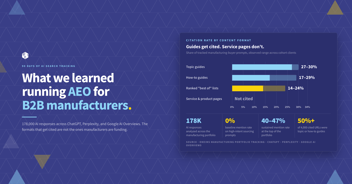
AEO focuses on helping your content work inside answer-driven, AI-powered experiences. The goal is for your content to become easier for search engines, AI engines, voice assistants, and answer surfaces to interpret and present. If someone asks a direct question, AEO improves the odds that your content can help shape the answer.
It usually involves writing with more clarity and structure, leading with the answer, using helpful headings, adding concise summaries, breaking down complex ideas in a way that is easy to follow, and getting to the point faster without stripping out the depth that makes the page valuable.
AEO is especially useful for B2B brands because buyers often start with specific questions. If your content answers those questions clearly and credibly, you have a better chance of earning visibility early in the journey.
Generative Engine Optimization (GEO): How Does Your Brand Influence AI-Generated Discovery & Recommendations?
Where AEO focuses on extractable answers, GEO is more about influence. It’s what makes your brand show up more credibly in AI-driven discovery—increasing the chances that generative AI systems recognize your brand, draw from your content, and reflect your expertise when they build responses.
These gains come from publishing source-worthy content: original insights, clear expertise, strong topical coverage, consistent brand signals, trustworthy claims, and useful material that is strong enough to be referenced.
For B2B companies, GEO is important because buyers are using AI tools to research problems, compare approaches, and build shortlists. If your company has no visible expertise in those environments, you risk disappearing from an important part of the decision process.
Putting It All Together: Search Everywhere Optimization
Search everywhere optimization is the bigger strategic mindset. This approach recognizes that buyers discover information in one place, so your brand shouldn’t rely on one place either.
A practical search everywhere strategy may include:
- Google search visibility
- AI answer visibility
- LinkedIn thought leadership
- YouTube and video search
- Industry publications and guest contributions
- Review platforms and directories
- Webinars, podcasts, and event content
- Community discussions and niche forums
- Branded knowledge assets that become reference points in your market
An omnipresent strategy especially important for B2B brands because trust usually grows through repeated exposure. Buyers rarely encounter your company once and convert. They encounter your ideas, your experts, your content, your proof points, and your perspective multiple times across the buying journey. And that repeated visibility creates momentum.
How to Diagnose What Actually Happened with Your Traffic
Before you panic and rewrite half of your website, you need to understand what changed. A good recovery plan starts with a solid diagnosis.
Break the Drop Down by Page Type
Start by grouping losses into categories.
Pages play different roles, so look at blog and resource content, product or service pages, industry pages, category pages, comparison pages, case studies, tools, and downloads.
If broad educational posts dropped but high intent pages stayed stable, that points to one kind of problem. If product and solution pages lost visibility, that points to another. If your rankings are flat but clicks are down on informational pages, that points to something different again.
The goal is to move from a vague site-wide story to a more useful pattern.
Break the Drop Down by Intent
Now, go one level deeper.
Separate informational, commercial, transactional, and branded intent.
Informational content is more exposed to answer extraction and zero-click behavior. Commercial and comparison content may still have stronger click potential if it helps buyers make decisions. Transactional or high intent pages may suffer more from relevance, quality, or trust issues if they lose position.
A site that loses early stage traffic is dealing with a different challenge than a site that loses high-intent visibility.
Review Impressions, Clicks, Clickthrough Rate, & Position Together
A lot of teams look at clicks first because clicks feel real. But there’s more to the story.
If impressions fell sharply, visibility likely fell. If impressions stayed healthy but clickthrough rate dropped, that may point to search engine results page (SERP) changes, answer extraction, or a mismatch between how your result appears and what searchers want. If average position slipped, it may suggest quality, relevance, trust, or competition problems.
You need the full picture.
Search the Queries You Lost
Don’t stop at dashboards. Go look at the actual search results.
What is showing up now that didn’t before? Are answer experiences pushing classic results down? Did a competitor publish a more practical guide? Are directories, forums, or distributors taking the space? Is the query producing more visual, video, or community based results?
The new SERP often tells you more than a spreadsheet can.
-Apr-07-2026-08-16-04-0553-PM.png?width=1920&height=1005&name=HubSpot%20Content%20Hub%20for%20Marketers%20(5)-Apr-07-2026-08-16-04-0553-PM.png)
The B2B Website Traffic Recovery Plan: Our 7-Phase Approach
Once you understand what changed, you can begin recovering that lost traffic.
Most B2B traffic loss problems come from a mix of technical drag, weak differentiation, trust gaps, and poor distribution. Each of the following phases tackles a different aspect of traffic loss—some are about diagnosis and cleanup, while others are focused on rebuilding, distribution, or measurement.
Tailor this plan to fit your needs.
Phase 1: Stabilize & Prioritize
Before you make major changes, you need a clear view of where the damage is, what matters most, and what can wait.
This phase is about triage. You’re trying to separate high-impact issues from noise so your team can move with focus instead of panic.
What to Review First
- Identify which pages lost traffic, rankings, or clickthrough rate most sharply.
- Separate losses by page type, such as blog posts, service pages, solution pages, industry pages, product pages, and case studies.
- Separate losses by intent, especially informational, commercial, and high-intent, conversion-focused content.
- Flag pages that influence qualified traffic, lead generation, booked meetings, quote requests, or pipeline.
- Mark pages that lost visibility but were never commercially meaningful so they do not distract the team.
What to Fix Immediately
- Broken pages, indexing issues, and technical errors affecting critical templates.
- Major mobile usability issues on top performing or high intent pages.
- Missing or weak internal links between educational pages and commercial pages.
- Thin service or solution pages that are supposed to support revenue but do not yet build trust or answer buyer questions well.
- Pages with clear intent mismatch, where the content no longer lines up with what the searcher wants.
The Goal
By the end of this phase, your team should have a prioritized recovery list. Not a giant spreadsheet of everything that looks imperfect but a ranked list of pages, topics, and technical issues that deserve immediate attention because they impact revenue, visibility, or strategic category positioning.
Phase 2: Fix Technical & Structural Weaknesses
Once priorities are clear, clean up the technical and structural issues that make recovery harder.
A lot of B2B teams want to jump straight into content rewrites, but if the site experience is weak, if important pages are hard to crawl, or if your templates create friction, even strong content will underperform.
Tighten Page Experience & Performance
- Review Core Web Vitals across key templates, especially on mobile.
- Improve pages with poor INP, LCP, or CLS scores.
- Reduce heavy scripts, third-party tags, and bloated elements that slow important pages down.
- Check navigation, sticky elements, forms, and other interactive components for friction.
- Make sure key landing pages are fast, readable, and easy to use on smaller screens.
Reduce Crawl Waste & Index Clutter
- Identify duplicate URLs, weak archive pages, parameter driven clutter, faceted pages, and thin legacy content.
- Consolidate pages that compete with each other for the same topic or keyword theme.
- Redirect outdated or duplicate pages into stronger destinations where appropriate.
- Review orphan pages and strengthen internal linking so important content is easier to find and easier to interpret.
- Tighten site architecture so priority pages sit closer to the core of the site.
Strengthen Site Structure for Buyers & Search Engines
- Review whether your service, solution, industry, and product pages are grouped logically.
- Make sure educational content connects naturally to commercial next steps.
- Add internal links that reflect the real buyer journey, not just SEO convenience.
- Improve page templates so they support deeper content, proof points, and easier navigation.
- Remove structural friction that forces buyers to work too hard to find the next relevant page.
The Goal
By the end of this phase, your site should be cleaner, easier to crawl, easier to navigate, and better equipped to support stronger rankings and stronger engagement.
Phase 3: Rebuild Content Around Expertise & Utility
Now, it’s time to make your existing and future content more useful, more credible, and harder to replace with a summary or generic competitor page. You need to be honest about what pages actually contribute.
Audit Priority Pages for Information Gain
Ask these questions page by page:
- Does this page say anything the top results do not already say?
- Does this page include firsthand experience, subject matter expertise, or practical detail?
- Does this page help a buyer make a better decision, or does it just explain the topic broadly?
- Would this page still be valuable if the reader already saw an AI summary before clicking?
- Does this page reflect what real prospects ask during sales conversations?
If the answer is no across most of those questions, the page needs deeper work.
Upgrade Pages Based on Their Role in the Journey
Different page types need different improvements.
Service and solution pages:
- Clarify the problem solved, the type of buyer served, and the business outcome.
- Add proof points, process visibility, industry relevance, and stronger differentiation.
- Replace vague agency language with sharper specifics.
Product, category, and industrial pages:
- Add application guidance, selection criteria, use case context, technical detail, certifications, and supporting assets.
- Include comparison tables, diagrams, FAQs, downloadable resources, or examples that help buyers evaluate fit.
- Move beyond short descriptions and spec fragments.
Educational content:
- Add expert commentary, real examples, practical recommendations, and original insight.
- Tighten the angle so the piece solves a real question instead of covering a topic in general terms.
- Connect the content more clearly to decision-making and next steps.
Comparison and decision stage content:
- Address tradeoffs honestly.
- Explain who each option is best for.
- Include buying criteria, implementation considerations, cost implications, or operational impacts.
Consolidate Weak or Overlapping Content
- Merge multiple weak articles into one stronger resource.
- Retire glossary style posts that no longer create meaningful value.
- Redirect redundant pages that split authority across the same topic.
- Keep the content library tighter, stronger, and more intentional.
- Focus your publishing calendar on gaps that matter to buyers and pipeline.
The Goal
By the end of this phase, your most important pages should be more useful, more differentiated, and more aligned with how B2B buyers actually research and evaluate options.
Phase 4: Strengthen Trust Signals Across the Site
Search visibility and buyer confidence are now deeply connected. If your site asks people to trust your company without showing the expertise behind the claims, your recovery will stall. You want to make credibility visible.
Make Authorship Real & Credible
- Replace generic bylines with real experts wherever possible.
- Build strong author pages with clear roles, experience, areas of focus, and professional background.
- Link to credible external profiles such as LinkedIn when relevant.
- Show why this person is qualified to speak on the topic.
- Keep author information consistent across the site.
Add Proof to Key Pages
- Use case studies, screenshots, diagrams, process visuals, or anonymized project examples.
- Add client outcomes that are specific enough to feel real.
- Include direct quotes, lessons learned, and examples from actual engagements where appropriate.
- Support major claims with visible evidence instead of generic statements.
- Look for places where the site sounds polished but unsupported, then fix that.
Strengthen Company-Level Trust
- Improve your About page so it reflects real expertise and market focus.
- Surface certifications, awards, partnerships, memberships, or credentials that matter to buyers.
- Review testimonials to make sure they describe outcomes, not just satisfaction.
- Tighten case studies so they show the problem, the approach, and the result.
- Make contact information, leadership visibility, and company background easier to verify.
The Goal
By the end of this phase, your site should feel more credible to both buyers and search systems. Trust should be visible in the content, in the authorship, and in the company story itself.
Phase 5: Build for AEO, GEO, & SEO
Once your foundation is stronger, you can make your content more effective in answer driven search environments. This phase is about making your pages easier to interpret, easier to summarize, and more likely to influence AI-driven discovery without stripping away depth.
Improve Extractability & Clarity
- Lead important sections with direct answers or short summaries.
- Use headings that reflect the way buyers actually phrase questions.
- Break down complex ideas into clear sections with logical flow.
- Add FAQ sections only where they add meaningful value.
- Make it easier for a reader or an answer engine to understand the main point quickly.
Create Content That Is Worth Citing or Referencing
- Publish original frameworks, observations, benchmark style insights, or expert perspectives.
- Turn internal knowledge into definitive guides, point of view articles, and practical resources.
- Expand beyond broad educational posts into stronger decision support content.
- Build topic clusters that reinforce your authority across related themes.
- Prioritize material that shows depth, specificity, and practical experience.
Improve Brand & Entity Clarity
- Keep company positioning consistent across your site, author pages, profiles, and external mentions.
- Make your core topics, services, industries, and expertise unmistakable.
- Align naming conventions, service descriptions, and topical focus areas.
- Reduce mixed signals that make it harder for search systems to understand what your brand is known for.
- Support your strongest topics with enough related content and proof to build real authority.
The Goal
By the end of this phase, your content should be better positioned to appear in answer-driven experiences and more likely to influence how your brand is represented in AI-powered discovery.
Phase 6: Expand Visibility Beyond Your Website
Recovery doesn’t end when a page ranks again. If your company only shows up on its own site, your visibility is still fragile.
To improve brand visibility and boost your chances of being referenced by search engines and AI tools, you have to extend your reach into the channels and platforms where B2B buyers validate ideas, compare vendors, and build trust.
Repurpose Strong Content into Other Formats
- Turn high-value articles into LinkedIn posts, short videos, webinar topics, and visual explainers.
- Pull strong insights from SMEs into quote graphics, short clips, or executive commentary.
- Repackage practical guides into checklists, slide decks, or downloadable assets.
- Use one strong idea across multiple formats instead of creating everything from scratch.
- Focus on consistency over random bursts of activity.
Build Expert Visibility Outside Your Domain
- Publish thought leadership from executives and SMEs on LinkedIn.
- Contribute to industry publications, podcasts, webinars, and association platforms.
- Look for opportunities to earn mentions, quotes, and references in credible third-party sources.
- Participate where your buyers already spend attention.
- Use off-site visibility to reinforce the expertise already shown on your site.
Support Repeated Exposure Across the Journey
- Make sure your strongest insights appear in more than one place.
- Build campaigns that connect search, social, email, and industry visibility.
- Reinforce major themes consistently so buyers associate your brand with the right expertise.
- Use distribution to strengthen recall, trust, and click behavior over time.
- Treat visibility as a system, not a one channel tactic.
The Goal
By the end of this phase, your brand should be easier to encounter, easier to remember, and easier to trust across the wider B2B research journey.
Phase 7: Reconnect Search to Pipeline
The final phase is where the recovery effort becomes a business strategy instead of a marketing project. Traffic matters, but traffic alone is not the goal. The real question is whether your search visibility is helping the right buyers find you, trust you, and move toward a conversation.
Measure What Actually Matters
- Track qualified organic traffic, not just total sessions.
- Measure visibility for high intent and commercially relevant topics.
- Review clickthrough rate on important pages and query groups.
- Connect content performance to leads, meetings, influenced opportunities, and pipeline.
- Watch how search contributes across the full buyer journey.
Use Sales & Marketing Signals Together
- Pull recurring questions and objections from sales calls into your content roadmap.
- Review which topics attract the best opportunities, not just the most traffic.
- Look at where prospects need more proof, more clarity, or more technical explanation.
- Use customer relationship management (CRM) and pipeline data to sharpen content priorities.
- Treat SEO, content, and revenue teams as connected.
Build an Operating Rhythm for Recovery
- Review performance in regular intervals instead of reacting to every fluctuation.
- Keep a living priority list of pages to improve, consolidate, or expand.
- Revisit topic gaps, distribution plans, and trust gaps quarterly.
- Use wins from one vertical, service line, or content type to inform the next set of priorities.
- Keep the strategy grounded in business outcomes rather than vanity metrics.
The Goal
By the end of this phase, search should be tied more closely to revenue, category visibility, and long-term growth. That’s when recovery starts turning into momentum.
Our 90-Day Action Plan
Need a starting point? Use this simple 90-day roadmap.
Days 1–30
- Audit traffic loss by page type, intent, and business value.
- Identify which pages matter most to revenue and visibility.
- Review the live search results for your highest priority losses.
- Fix urgent technical issues that harm usability, crawlability, or mobile experience.
- Audit trust signals on key service, solution, and commercial content.
- Build a prioritized recovery list instead of treating everything as equally urgent.
Days 31–60
- Consolidate overlapping or weak content.
- Rewrite priority pages with more expertise, proof, and practical value.
- Improve internal links between educational content and commercial pages.
- Upgrade author pages, bylines, company trust pages, and case studies.
- Add clearer answer-first formatting where it supports the reader.
- Map content gaps for high intent, industry specific, or buyer decision content.
Days 61–90
- Publish stronger replacement assets for weak legacy content.
- Launch expert driven content tied to real buyer questions and sales friction points.
- Repurpose key insights into LinkedIn posts, short videos, webinars, or industry contributions.
- Track changes in visibility, clickthrough rate, qualified traffic, and lead quality.
- Adjust the roadmap based on what is improving and where buyers still need more support.
What Does Winning Look Like in 2026?
For a long time, winning in search felt easy to define: rank on page one, reach the top spot for valuable keywords, drive more organic sessions, and post content that brings in steady website traffic month after month.
In 2026, success in search is broader, more layered, and far more tied to how buyers actually discover and evaluate vendors—so B2B teams need to rethink what “winning” actually means.
Then: Winning Used to Be Mostly About Rankings & Traffic
The old model of success focused heavily on position and volume.
If your pages ranked near the top of the search results and organic sessions were climbing, that was usually treated as proof that the strategy was working. In many cases, that was a fair assumption! Rankings and traffic were strong leading indicators because buyers still clicked through traditional results more consistently, and search was more concentrated inside Google.
Today, those same metrics still matter, but they no longer tell the full story.
A number one ranking does not mean what it used to if an AI summary, a featured answer, a review platform, or a video result captures the attention first. High-traffic doesn’t hold much value if the visitors are low intent, low fit, or unlikely to turn into opportunities. And a drop in organic sessions is not always a sign that your brand is losing relevance everywhere that matters.
Now: Winning Means Being Visible & Trusted Across the Full Buyer’s Journey
Today, winning in search goes beyond rankings to include showing up across the full buyer journey and giving people a reason to trust your brand.
B2B buyers move between Google, AI assistants, LinkedIn, YouTube, review sites, industry publications, webinars, forums, and third-party resources as they research, compare, and validate options. Ranking high on Google isn’t enough anymore. Your brand needs to be visible in the places buyers actually use, and your content needs to be clear, credible, and useful enough to influence decisions.
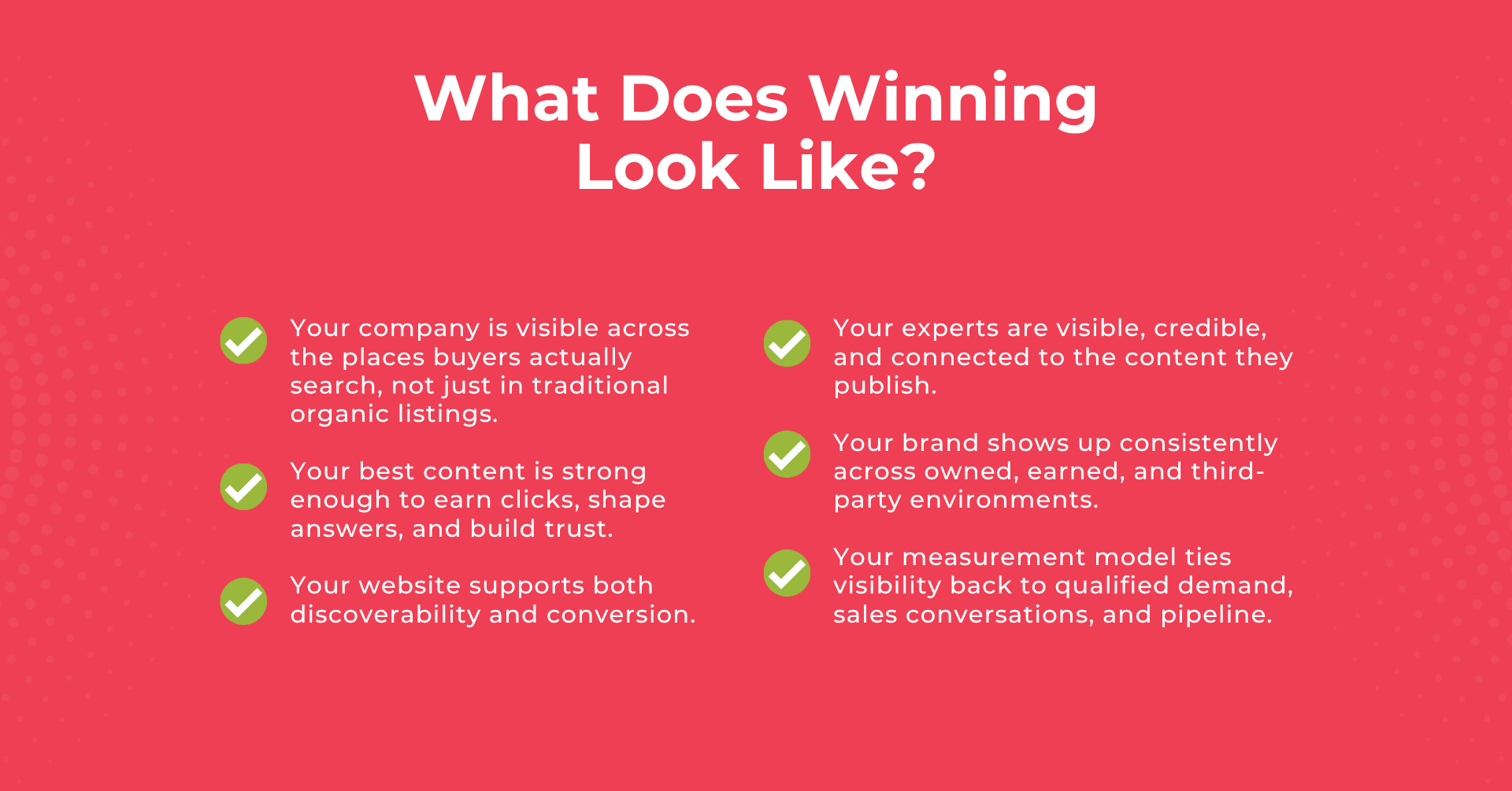
Winning now looks like this:
- Your company is visible across the places buyers actually search, not just in traditional organic listings.
- Your best content is strong enough to earn clicks, shape answers, and build trust.
- Your website supports both discoverability and conversion.
- Your experts are visible, credible, and connected to the content they publish.
- Your brand shows up consistently across owned, earned, and third-party environments.
- Your measurement model ties visibility back to qualified demand, sales conversations, and pipeline.
That’s what winning looks like in 2026: becoming the brand buyers trust as they move through a more fragmented and AI-driven search journey.
FAQs
Conclusion
SEO still matters, but today’s B2B brands need a broader visibility strategy built for how buyers actually research, compare, and validate options today. You have to show up across search, AI-driven discovery, third-party platforms, industry sources, and the other places that shape trust and influence decisions.
The good news: You don’t have to do this alone. We’re here to help.
At OneIMS, we help B2B organizations build the strategic foundation, content systems, and authority signals needed to compete across search, AI, social, and the broader discovery ecosystem. We work with our clients to strengthen visibility on Google, increase the chances of being surfaced in AI-driven experiences, build credibility in competitive markets, and tie optimization efforts back to real business goals.
If you’re ready to build a search everywhere optimization strategy that reflects how buyers search today and how discovery is changing tomorrow, schedule a consultation today. We can help you uncover what is driving the drop, identify where your visibility strategy is falling short, and build a smarter plan to grow awareness, trust, and qualified pipeline.