Table Of Contents
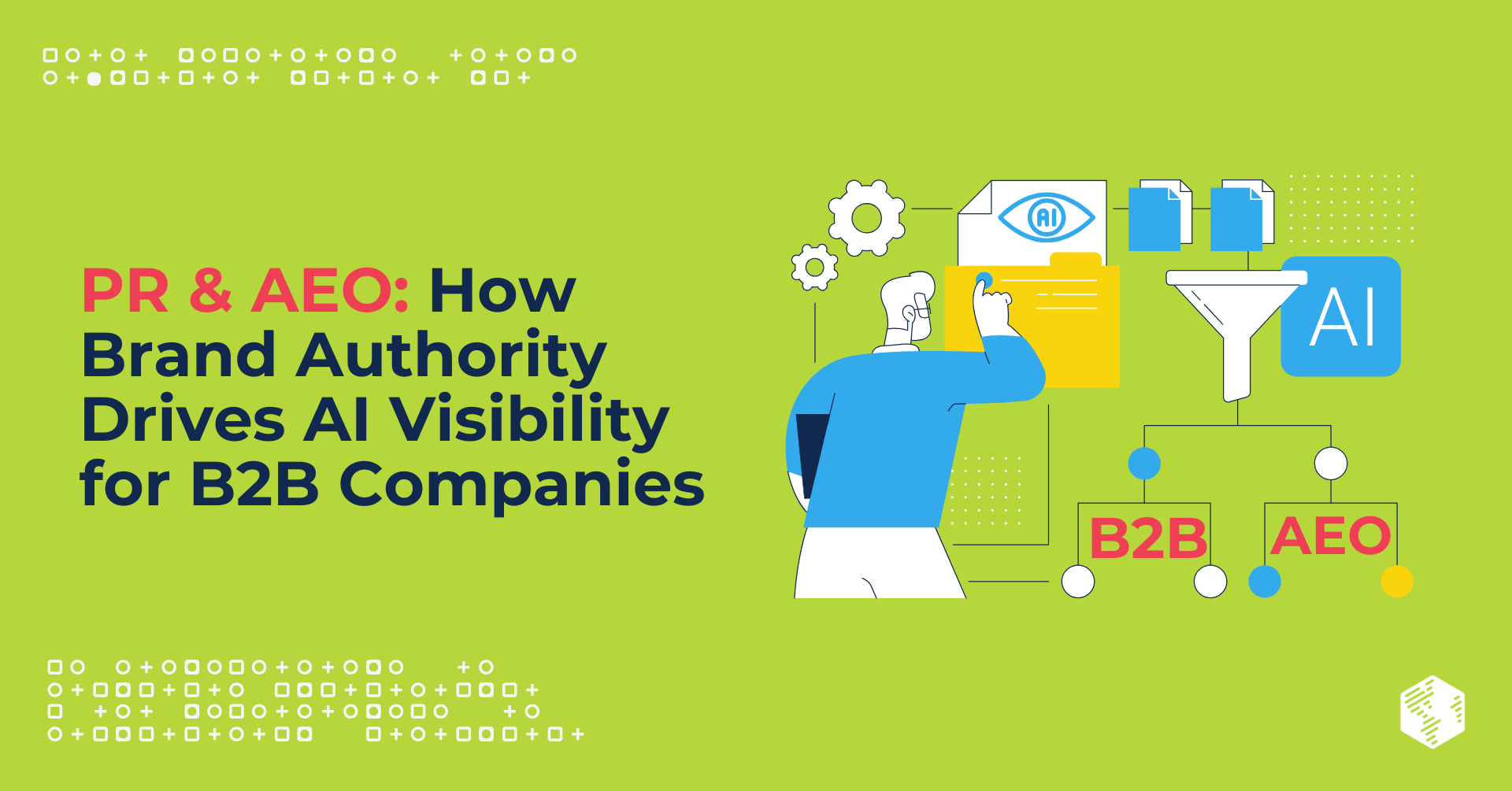
As buyers turn to AI tools for recommendations, comparisons, vendor research, and problem-solving, showing up in traditional search is just one part of staying visible. AI systems need to recognize who your company is, understand what you do, connect your brand to the right topics, and find enough credible evidence to trust your authority.
Public relations (PR) has become a major part of answer engine optimization (AEO). Media placements, podcast appearances, executive thought leadership, partner pages, expert quotes, industry contributions, and community involvement all help strengthen the external signals that support your brand’s authority.
PR helps create the third-party evidence AI systems need to understand, verify, and cite a brand. And when done well, it turns authority from a claim on your website into a pattern the broader web can confirm.
For companies that want to stay visible as search shifts from links to answers, PR is becoming one of the most important levers.
-May-01-2026-10-32-03-4296-PM.png?width=1920&height=1005&name=HubSpot%20Content%20Hub%20for%20Marketers%20(2)-May-01-2026-10-32-03-4296-PM.png)
Why Many B2B Companies Are Losing Visibility in AI Responses
Many B2B brands have strong content but weak authority signals. They may rank in Google, publish regularly, and have useful service pages, yet still fail to appear when AI tools generate vendor recommendations, comparisons, or category shortlists.
The problem (usually) isn’t bad content. More often, it means the company may have useful pages on its website, but not enough credible external signals to support its claims.
AI-generated answers are influenced by more than what a brand says about itself. They are shaped by the broader evidence available across the web. AI systems need to understand who the company is, what it does, what topics it is associated with, who trusts it, and whether credible external sources support its positioning.
And that’s exactly where many B2B brands fall short. They may have strong content, proven expertise, and real client results but not enough third-party recognition to validate that authority publicly. From an AEO perspective, it creates a trust gap.
Their Visibility Strategy Is Still Too Website-Centric
Many companies still think visibility starts and ends with their own website. That made more sense when the primary goal was ranking individual pages in traditional search results.
AI search is different. Visibility is becoming less page-centric and more entity-centric.
An AI-generated answer may summarize information from multiple sources, compare known brands, evaluate patterns of credibility, and reference sources that appear trustworthy for the question being asked.
Your website is still important, but it’s only one part of the equation. For example, if your company claims to specialize in packaging equipment on your website, but few outside sources mention your brand in that context, AI systems have less evidence to support that association.
In traditional SEO, a strong page might still rank. In AI search, the brand itself also has to be understood and validated.
Their Brand Is Not Clear Enough as an Entity
AI systems need entity clarity. They need to understand your company as a distinct, recognizable brand, and they try to connect your name, services, audience, leadership, expertise, and reputation into a clear picture.
It sounds simple, but many B2B companies make this process difficult:
- Their website says one thing, and their LinkedIn page says another.
- Their founder’s bio focuses on a different area of expertise.
- Their podcast descriptions and speaker profiles are inconsistent or outdated.
- Their partner and directory listings use generic language.
- Their service pages emphasize one audience, while their external mentions reinforce a different market or category.
This kind of inconsistency weakens AI visibility because it makes the brand harder to understand.
They Lack Third-Party Evidence of Their Authority
AI systems need evidence. Buyers do too.
A company can publish strong content about its own expertise, but self-published content has limits. If the broader web doesn’t support the brand’s claims, AI systems may have less reason to view the company as a trusted source or recommendation.
This lack of evidence is especially important in B2B, where buying decisions involve risk. A prospect is not only asking “Who has written about this topic?” but also “Who seems credible? Who is recognized? Who understands my industry? Who can I trust with a serious business decision?”
When evidence supporting the answers to those questions is missing, a brand may be known to its clients but nearly invisible to the broader web, which makes it harder for AI systems to verify the company’s expertise and harder for buyers to find confidence before they reach out.
Their Reputation Signals Are Too Thin, Outdated, or Fragmented
Even when a company has some external visibility, those signals may not be strong enough to support AI visibility.
The issue is not always a lack of mentions. Sometimes, the problem is that the existing mentions are outdated, inconsistent, incomplete, or disconnected from the company’s current positioning. A brand might appear on podcast pages, partner profiles, directories, review sites, social platforms, and industry websites, but if those sources describe the company in different ways, they create a weaker authority signal. Instead of reinforcing one clear identity, the broader web gives AI systems a scattered picture to interpret.
AI tools pull context from the wider public footprint around your brand. If that footprint is thin or fragmented, AI systems may have less confidence in how to understand, summarize, or recommend your company.
-May-01-2026-10-32-03-5989-PM.png?width=1920&height=1005&name=HubSpot%20Content%20Hub%20for%20Marketers%20(3)-May-01-2026-10-32-03-5989-PM.png)
PR as a Core Driver of AI Visibility
PR has always been tied to credibility, but in the context of AEO, its role is expanding.
Today, a substantial benefit of strong PR is helping the market, buyers, search engines, and AI systems understand your brand more clearly. Every meaningful media mention, podcast interview, expert quote, industry contribution, partnership, event appearance, review, and community initiative can help answer one important question: Does the broader web support what this brand claims to be?
PR Goes Beyond Reputation Management
Many companies still think of PR as something they need when they launch a product, announce a hire, win an award, raise funding, or respond to a crisis. That view is too limited.
In the AI search era, PR should be part of an ongoing visibility strategy to help your brand show up in the places your buyers, your industry, and AI systems already look for trusted information.
Think beyond traditional media. For example:
- A podcast interview with a respected industry host can reinforce founder authority
- A guest article in a niche publication can connect your brand to a specific buyer problem
- A quote in an expert roundup can associate your company with a category trend
- A partnership page can validate your role in a larger ecosystem
- A speaking opportunity can position your team as a trusted voice
- A community initiative can show that your company is active, visible, and connected beyond its own sales funnel
AI visibility is shaped by patterns. One isolated mention may not change much, but repeated, relevant mentions across trusted environments can strengthen how your brand is understood.
Digital PR Creates Authority Signals AI Can Recognize
Digital PR gives your brand more surface area across the web. For B2B companies, useful PR activity can include the following:
- Media visibility, including trade publications, business journals, expert quotes, and industry articles
- Executive visibility, including podcast appearances, speaking opportunities, bylined content, thought leadership, and webinar participation
- Ecosystem visibility, including partner pages, association memberships, co-marketing initiatives, and community involvement
- Proof building, including awards, reviews, original research, customer stories, analyst mentions, and trusted directory profiles
Keep in mind that a random low-quality mention is not the same as a thoughtful placement in a trusted industry resource. Relevance, credibility, and consistency are what set these activities apart.
The goal is to appear in the right places, with the right message, around the right topics.
Trusted Third-Party Environments Are Key
Your website tells buyers what you want them to believe. Third-party sources help validate whether the market sees you that way too. A company can publish dozens of articles about a topic. But if no credible outside sources connect that company to the same topic, the authority signal is incomplete.
Third-party environments create stronger evidence because they are not controlled entirely by the brand. Examples include:
- Industry publications
- Trade media
- Business journals
- Podcast platforms
- Partner websites
- Review sites
- Professional associations
- Conference and event pages
- Community organizations
- Educational resources
- Research reports
- Analyst or directory platforms
These sources help establish that your brand is part of a broader conversation. For AI systems, that broader conversation can provide useful context. For buyers, it builds trust before they ever speak with your sales team.
PR Helps AI Understand What Your Brand Should Be Known For
PR is not just about getting your brand mentioned but also about shaping the associations around your brand. A mention is more valuable when it reinforces a topic you want to own. For example, if your company wants to be known for supply chain automation, that topic should appear consistently across your service pages, executive bios, guest articles, podcast introductions, partner profiles, media quotes, webinar descriptions, case studies, LinkedIn profiles, and industry directories.
The more consistently those associations appear across credible sources, the easier it becomes for AI systems to understand the brand’s identity—turning brand positioning from a claim into a pattern.
-May-01-2026-10-32-03-7953-PM.png?width=1920&height=1005&name=HubSpot%20Content%20Hub%20for%20Marketers%20(4)-May-01-2026-10-32-03-7953-PM.png)
How PR Influences AI Systems
AI systems differ in how they gather, process, retrieve, summarize, and cite information, but the strategic connection between PR and AI visibility is clear.
AI systems rely on available information. Generally, they look for patterns, evaluate sources, summarize what they can understand, and are more likely to reference brands that are clearly connected to a topic and supported by credible evidence.
PR helps create that evidence.
Here are the key ways PR can influence AI visibility.
Entity Recognition
AI systems need to recognize your company as a specific entity. That means your brand name, website, executives, services, market, and areas of expertise need to be connected across the web.
PR helps create those connections. When your company appears in industry articles, podcast pages, event listings, partner websites, and expert commentary, it gives AI systems more opportunities to identify your brand and associate it with relevant topics. A clear and consistent public footprint helps reduce ambiguity.
This recognition is especially useful for companies with names that are similar to other brands, companies operating in crowded categories, or businesses trying to expand into a new market position.
Topical Association
AI visibility depends heavily on what your brand is known for.
If your company wants to appear in AI answers around a specific service, industry, buyer problem, or category, those associations need to show up repeatedly across the web.
PR helps create that necessary topical association by placing your brand in conversations around those subjects:
- An executive quote can support your association with a specific industry trend.
- A podcast appearance can reinforce your expertise around a buyer problem.
- A partner page can connect your company to a trusted ecosystem.
- A guest article can strengthen your association with a category or use case.
Over time, these signals help connect your brand with the topics you want to own.
Trust Reinforcement
Trust is central to B2B decision-making and to AI visibility. If all authority claims come from your own website, the signal is weaker. If those claims are supported by respected third-party sources, the signal becomes stronger. PR helps reinforce trust by showing that others recognize your expertise.
For many B2B companies, niche credibility matters more than broad exposure. A mention in a respected trade publication, a podcast your buyers actually listen to, or an association page your market trusts can carry more strategic value than a broad placement with little category relevance.
Narrative Consistency
AI systems summarize what they can find. If the information about your company is inconsistent, the summary may be incomplete, generic, or inaccurate.
Consistency is key. Your company boilerplate, executive bios, service descriptions, podcast bios, contributor profiles, partner listings, and directory descriptions should all reinforce the same core identity. PR gives you more places to reinforce that narrative. When those places tell a consistent story, AI systems and buyers can understand your brand faster.
Source Diversity
A strong AI visibility strategy should depend on a range of channels. Your website and blog are still important, but your brand also needs outside validation.
Source diversity means your company appears across different types of credible environments. For example:
- Owned content explains your expertise.
- Media coverage validates your relevance.
- Podcast appearances humanize your leadership.
- Partner pages confirm ecosystem trust.
- Reviews support customer confidence.
- Speaking engagements and industry contributions show recognition.
- Original research gives others something to cite.
Together, these sources build a richer brand footprint, and that broader footprint can help AI systems form a more complete understanding of your company.
Freshness & Recency
AI visibility is not static. If the most visible information about your company is outdated, thin, or disconnected from your current positioning, AI systems may not reflect who you are today.
Ongoing PR helps keep your public presence fresh. New podcast appearances, expert quotes, partner updates, industry contributions, event listings, research reports, and media mentions all add current signals to the web.
Fresh, recent signals matter even more as AI-powered search tools increasingly work with recent or live web information. A company that actively participates in current conversations gives AI systems and buyers more up-to-date evidence of its relevance.
-May-01-2026-10-32-03-7509-PM.png?width=1920&height=1005&name=HubSpot%20Content%20Hub%20for%20Marketers%20(5)-May-01-2026-10-32-03-7509-PM.png)
AEO & PR: Where Does PR Fit?
A strong AEO strategy consists of three layers: content, technical optimization, and authority. PR belongs in the authority layer, but it works closely with the other two.
Layer 1: Content
Content is the information layer. From clear service pages and comparison content to FAQs and original insights, content gives AI systems and buyers the material they need to understand your expertise.
For AEO, content should be easy to understand, summarize, and reference. It needs to answer real buyer questions, explain problems clearly, define terms, compare options, provide context, and connect pain points to solutions.
But content alone does not create full authority. You can publish the best article in your industry, but if your brand has no external credibility, AI systems may still favor sources or companies with stronger authority signals.
Layer 2: Technical Optimization
Technical optimization is the accessibility and clarity layer that helps search engines and AI systems access, parse, and interpret your content. It includes:
- Clean site architecture
- Crawlable pages
- Logical internal linking
- Structured data where appropriate
- Clear authorship
- Fast and accessible pages
- Entity-focused page structure
- Consistent naming conventions
- Optimized metadata
- Well-organized headings
Technical optimization reduces friction. It makes your website easier to crawl, supports both traditional SEO and AEO, and helps clarify relationships between pages, authors, services, topics, and entities.
However, a technically clean website can still lack authority if the broader web does not validate the brand.
Layer 3: Authority
Authority is the trust layer, where PR plays a major role. It helps AI systems validate the brand beyond what the brand says about itself.
This layer is where many B2B companies are weakest. They create content, improve their website, and optimize pages but forget to build enough external proof. That creates a major visibility gap because both AI systems and buyers need more than self-published claims.
The simplest way to think about it:
- Content tells AI what you know.
- Technical optimization helps AI access and understand it.
- PR gives AI more reasons to trust it.
All three layers are needed for any effective B2B AEO strategy.
-May-01-2026-10-32-03-8116-PM.png?width=1920&height=1005&name=HubSpot%20Content%20Hub%20for%20Marketers%20(6)-May-01-2026-10-32-03-8116-PM.png)
How to Build a PR & Brand Authority System for B2B AEO
Most companies approach PR reactively. They wait until they have an announcement, pitch a few publications, and try to get a quick mention. Then they stop.
That’s not enough for AEO.
AEO requires a more consistent authority-building process that makes your company easier to understand, verify, and cite over time. Follow these steps to get started.
Step 1: Define the Brand Identity AI Should Understand
Before your team pitches podcasts, updates profiles, writes thought leadership content, or pursues media coverage, define the identity you want the market and AI systems to understand.
Start by documenting:
- What category your company belongs in
- What services or solutions you want to be associated with
- What buyer problems you solve
- What industries or markets you serve
- What terms should consistently appear near your brand
- Which executives or experts represent your authority
- What point of view makes your company different
- What proof supports your credibility
Once your brand identity is documented, it becomes easier to evaluate opportunities. A podcast pitch, media quote, guest article, partner page, or event appearance should not be pursued if it only offers exposure. Opportunities need to help strengthen one of the brand associations you want AI systems and buyers to remember.
If you don’t define your brand identity clearly, AI systems will rely on whatever scattered information they can find.
Step 2: Audit Your Current AI Visibility & Brand Footprint
Review how your brand currently appears across AI tools and the public web. The audit should reflect how buyers actually research. Go beyond your company name; test category, problem, and comparison prompts that a prospect might use before they know which vendor to contact.
Test prompts that reflect real buyer behavior, such as:
- Who are the top companies for [your category]?
- What are the best agencies for [your service]?
- Which companies help with [buyer problem]?
- What should I look for in a [type of partner]?
- Compare [your brand] vs. [competitor].
- What is [your brand] known for?
Evaluate the results carefully. You want to understand how AI systems currently interpret your market position:
- Does your company appear?
- Do competitors appear instead?
- How does AI describe your brand?
- Is the description accurate?
- Which sources are cited?
- Which topics are associated with your company?
- Are your executives or subject matter experts recognized?
- Are outdated descriptions showing up?
- Are important services missing?
These answers can reveal where your brand is clear, where it’s invisible, and where the public web may not support the story you want buyers to believe.
This audit should also include the broader web. Look at your company profiles, founder bios, podcast appearances, media mentions, guest articles, partner listings, directories, review platforms, association pages, event pages, and social profiles. Search for gaps between how you want to be known and how the web currently describes you. That gap is where your PR and authority strategy should begin.
Step 3: Identify Your Authority Gaps
Once you know where you stand, identify what’s missing.
Authority gaps are the missing proof points between what your brand claims and what the broader web confirms. Some gaps are easy to spot, like outdated bios or thin directory profiles. Others are more strategic, such as weak founder visibility or a lack of third-party mentions around your most important services.
Common authority gaps include:
- Few or no third-party mentions for priority topics
- Limited founder or executive visibility
- No consistent podcast presence
- Few guest articles or industry contributions
- Weak partner ecosystem visibility
- Inconsistent company descriptions
- Outdated executive bios
- Thin review presence
- Little community involvement
- No proprietary research or original data
- Few relevant backlinks from trusted sources
- No clear point of view in the market
After you identify these gaps, prioritize the ones that most directly affect your desired AI visibility. A manufacturing company trying to be known for plastic extrusion, for example, should prioritize expert commentary, partner mentions, case studies, and third-party content that reinforces that exact category.
The key question is simple: “Do we have enough external evidence connecting our brand to the topics we want to own?” If the answer is no, your AI visibility may remain limited, even if your website content is strong.
Step 4: Build a Topic-Driven PR Plan
Random PR creates random signals, but effective AEO needs focused signals.
Your PR strategy should be built around the topics your brand wants to be known for. Rather than asking, “Where can we get mentioned?” ask, “What do we need to be known for, and where should that proof appear?”
First, create topic clusters. These might include:
- Category topics
- Buyer pain topics
- Industry trend topics
- Founder expertise topics
- Customer outcome topics
- Competitive differentiation topics
- Local or community topics, where relevant
- Partner ecosystem topics
Then, for each topic, define the audience, core message, proof points, best third party channels, internal spokesperson, supporting content assets, and desired AI association.
This planning step keeps your PR from becoming a collection of disconnected mentions. Each topic cluster should point back to a specific brand association you want to strengthen across the web and reinforce the brand identity you want AI systems and buyers to understand.
Step 5: Turn Internal Expertise Into Public Assets
Most B2B companies have more expertise than they have visibility. The knowledge exists, but it’s trapped in sales calls, strategy sessions, client work, internal messages, onboarding documents, proposals, webinars, and team meetings.
PR helps bring that expertise into public view.
The best PR starts with something worth saying—like a contrarian point of view, a data-backed insight, a useful framework, a customer trend, or a practical lesson your team has learned from real client work.
Start by turning internal knowledge into assets that can be pitched, quoted, cited, and repurposed. Examples include:
- Original research
- Trend reports
- Benchmark data
- Executive bylines
- Expert commentary
- Customer success stories
- Opinion articles
- Podcast talking points
- Webinar topics
- Industry predictions
- Practical frameworks
- Problem-specific guides
Proprietary insights are especially valuable because they give journalists, podcast hosts, partners, and industry publishers a stronger reason to include your brand. They also give AI systems more specific information to associate with your expertise.
AI systems and human readers are surrounded by generic content. Original ideas, real data, specific experience, and clear points of view are more useful and more defensible. The more useful your expertise becomes to the market, the more authority your brand can build.
Step 6: Expand Into Trusted Third-Party Channels
When your topics and assets are clear, build a repeatable process for external visibility.
Pick and choose which third-party channels to prioritize. For AEO, the best channels are the ones that strengthen credibility with your buyers and reinforce the topics you want AI systems to connect with your brand. They may include:
- Industry publications
- Trade media
- Business journals
- Podcasts
- Partner blogs
- Association websites
- Webinar collaborations
- Event pages
- Review platforms
- Analyst profiles
- Contributor networks
The key is to prioritize relevance over volume. A smaller, highly trusted industry source can be more useful than a broad placement that has no connection to your market.
Don’t chase every media opportunity. Instead, focus on appearing where your buyers, partners, peers, and industry influencers already pay attention.
Ask:
- Which publications shape our industry?
- Which podcasts do our buyers listen to?
- Which associations matter in our market?
- Which partner ecosystems influence trust?
- Which communities are our buyers part of?
- Which review platforms affect vendor shortlists?
- Which events signal expertise in our category?
Then build an outreach rhythm. PR is not a quarterly activity. It should be a recurring part of your growth system.
Step 7: Standardize Brand & Expert Messaging Across the Web
Consistency matters more than many companies realize. If your company is described differently everywhere, AI systems may struggle to understand the brand. Buyers may feel the same confusion.
A messaging kit gives your team a shared source of truth. It also makes it easier for external partners, podcast hosts, event organizers, journalists, and directories to describe your company accurately.
Create a standardized messaging kit that includes:
- Company boilerplate
- Founder bio
- Executive bios
- Service descriptions
- Category language
- Target audience description
- Core proof points
- Priority links
- Headshots and titles
- Podcast guest bios
- Event speaker profiles
- Partner profile descriptions
- Approved language for public profiles, such as Google Business Profile, where relevant
This kind of consistency is easy to overlook, but it makes all the difference. Every profile, bio, and external mention is another small signal that can either clarify your brand or muddy the picture. They don’t need to sound identical, but your core message should align across them all.
This practice is especially important for founder-led or expert-led B2B companies.
Executives often become trust carriers for the brand. Their bios, interviews, articles, and speaking topics should support the company’s authority strategy. When the people and the company are clearly connected to the same areas of expertise, the entity signals become stronger.
Step 8: Connect PR Activity Back to Owned Content
Every meaningful PR activity should connect back to your broader content, SEO, AEO, and demand generation strategy.
This practice is where many companies leave value on the table. They earn a mention, publish a guest article, appear on a podcast, or join a webinar, but they never connect that activity to the rest of their visibility strategy.
For example:
- A podcast appearance can link to a related guide.
- A media quote can support a service page topic.
- A guest article can connect to a pillar page.
- A webinar can support a downloadable resource.
- A research report can fuel blog content, sales enablement, media outreach, and follow-up campaigns.
These connections help create a stronger information ecosystem and help buyers move from third-party discovery to deeper education on your owned channels. The goal is to turn every strong external signal into part of a larger visibility system.
When these pieces work together, AEO becomes a visibility system supported by owned content, technical clarity, external authority, and demand generation.
Step 9: Measure AI Visibility & Authority Signals Over Time
PR for AEO should be measured differently from traditional PR. Impressions and media logos are not enough. The real question is whether your brand is becoming more visible, more trusted, and more accurately represented in AI-driven discovery.
Measurement should look at both visibility and interpretation. Appearing in AI results is one thing, but you also need to know whether AI systems are describing your company accurately and associating it with the right topics.
Track metrics across four categories:
- AI visibility: Brand mentions in AI responses, citation frequency, accuracy of AI-generated descriptions, competitor presence, and topic associations
- Authority growth: Third-party mentions, referring domain quality, podcast appearances, media placements, partner profiles, and executive visibility
- Demand signals: Branded search growth, direct traffic, referral traffic, assisted conversions, and sales conversations influenced by PR activity
- Narrative quality: Whether AI tools describe your company accurately, cite relevant sources, and connect your brand to the right services, markets, and problems
These metrics will not always fit neatly into a traditional attribution model, especially as AI search continues to evolve, but they can show whether your brand is becoming more visible, more trusted, and more clearly understood over time.
You should also track qualitative changes:
- Are AI tools describing your company more accurately?
- Are you appearing for more category prompts?
- Are competitors still dominating certain topics?
- Are cited sources reflecting your desired positioning?
- Are prospects referencing podcasts, articles, interviews, or media placements in sales conversations?
AEO is still evolving, so measurement will continue to mature. The brands that start earlier will have more time to create the public evidence AI systems and buyers can recognize.
Quick Wins for the First 90 Days
Authority takes time, but momentum can start quickly. In just 90 days, you can start to create a foundation, activate the right channels, and build repeatable authority signals.
Days 1–30: Audit & Foundation
During the first month, focus on clarity. Begin by understanding where your brand stands today:
- Test 10–15 AI prompts across category, problem, and comparison searches.
- Identify prompts where your brand should appear but does not.
- Audit public profiles, founder bios, partner pages, directory listings, and third-party mentions.
- Update your company boilerplate and executive bios for consistency.
- Build a list of priority topics and trusted third-party channels.
By the end of the first 30 days, you should have a clearer picture of your current AI visibility, authority gaps, and messaging foundation.
This work may not feel flashy, but it is important. Without it, your PR strategy will lack direction.
Days 31–60: Activate Authority Channels
In the second month, begin creating new external signals:
- Pitch executives to relevant podcasts.
- Submit expert commentary to industry publications.
- Identify guest contribution opportunities.
- Update partner profiles, directories, and marketplace pages.
- Build a simple media kit with bios, topics, proof points, and priority links.
The goal is to place your brand in relevant environments that reinforce your desired authority. If your company wants to be known for printing and signage, don’t pitch generic business topics. Pitch specific ideas about direct mail data management, retail packaging, integrated campaigns, influencer boxes, or small business signs.
Specificity builds stronger signals.
Days 61 to 90: Reinforce & Connect
In the third month, connect the activity back to your owned ecosystem:
- Connect PR mentions to relevant owned assets.
- Create supporting content around topics gaining traction.
- Repurpose media and podcast features into sales and content assets.
- Track changes in target AI prompts.
- Build a monthly PR and authority calendar.
By the end of 90 days, you should have the beginning of a repeatable authority system that answers four questions:
- What do we want to be known for?
- Where do we need to be visible?
- What evidence supports our authority?
- How do we keep reinforcing that authority over time?
Those questions are central to AEO.
FAQs About PR & AEO
Conclusion
AEO helps AI systems and buyers understand why your brand deserves to be included in the answer. It requires helpful content, technical clarity, and a broader authority system that proves your expertise beyond your own website.
PR plays a critical role in that system because it creates third-party evidence across the web, places your brand in trusted environments, connects your company to the topics you want to be known for, and strengthens the public proof behind your expertise.
If your company is investing in content but still struggling to show up in AI-generated answers, the issue may be authority.
At OneIMS, we help B2B companies build the strategy, content, and visibility systems needed to compete in AI-driven search. From AEO and GEO to demand generation and brand visibility, our team helps your company show up where modern buyers are already looking for answers.
Schedule a consultation today to learn how to strengthen your AI visibility and turn brand authority into a growth advantage.