

Table Of Contents
B2B buyers rarely make decisions overnight. They research, compare, analyze, and evaluate options long before speaking with a sales team. But while buyers leave few direct clues, they constantly drop subtle (and not-so-subtle) hints about their interests and priorities.
These behavioral breadcrumbs, known as intent signals, hold the key to understanding buyer motivation at every stage of their journey. When properly identified and acted upon, intent signals can transform how B2B marketing and sales teams attract, engage, and convert high-value accounts.
What Are Intent Signals?
Intent signals are the measurable actions and behaviors prospects display that reveal their interests, challenges, pain points, or buying readiness. They include everything from an individual searching for a specific solution to an entire buying committee repeatedly visiting your product pages.
Each action, whether large or small, builds a clearer picture of what that prospect values, what questions they’re trying to answer, and how close they are to making a purchase decision.
Importantly, intent signals don’t just show what someone is doing; they reveal why they’re doing it. A prospect who reads a thought leadership article may be exploring the landscape, while one who downloads a pricing guide is signaling a far stronger intent to purchase.
When aggregated, these signals become powerful indicators of where accounts are in the funnel, enabling marketers and sales teams to focus their energy on the opportunities most likely to close.
-Aug-15-2025-08-34-00-5849-PM.png?width=1920&height=1005&name=HubSpot%20Content%20Hub%20for%20Marketers%20(2)-Aug-15-2025-08-34-00-5849-PM.png)
Types of Intent Data
Intent data falls into three broad categories, each offering a unique layer of insight: first-party data, second-party data, and third-party data. When combined, they form a comprehensive view of buyer behavior and describe a wide range of intent signals.
First-Party Intent Data
First-party intent data is the most direct and reliable type of intent data because it comes straight from your own properties. It tells you how prospects are interacting with your brand and what they find valuable.
Examples include the following:
- Website visits and page views
- Content downloads (ebooks, white papers, reports)
- Webinar registrations and attendance
- Email engagement (opens, clicks, replies)
- Demo requests, free trials, or chat interactions
This type of intent data offers a direct line of sight into how people respond to your messaging. By analyzing these behaviors, you can segment prospects more effectively, identify which content resonates, and pinpoint accounts showing strong signs of progression toward purchase.
2. Second-Party Intent Data
Second-party intent data comes from a trusted partner or vendor who shares their own first-party data with you. This arrangement provides valuable insights into how your potential buyers behave outside of your own ecosystem.
For example:
- A review platform sharing which products or services users are comparing
- Event organizers providing attendee engagement data
- Webinar platforms sharing audience participation trends
- Industry associations sharing research activity
- Media companies providing insights into readership behavior
Second-party data broadens your field of vision, helping you understand what prospects do in environments closely related to your solution. As an external layer of insight, it can validate your first-party data as well as reveal hidden opportunities.
3. Third-Party Intent Data
Third-party intent data captures activity from across the wider internet. It aggregates patterns and signals from a variety of sources and offers a more broad perspective on market demand and buyer interest.
Examples include the following:
- Searches for industry keywords across multiple websites
- Engagement with online trade publications
- Forum participation or question-and-answer site activity
- Social media activity around trending topics
- Content consumption tracked by data providers
Third-party intent data paints the bigger picture, highlighting buyers who may not yet be in your pipeline but are actively researching solutions like yours. It allows you to expand your reach, uncover new accounts, and act before competitors even know those prospects exist.
-Aug-15-2025-08-34-07-2849-PM.png?width=1920&height=1005&name=HubSpot%20Content%20Hub%20for%20Marketers%20(3)-Aug-15-2025-08-34-07-2849-PM.png)
6 Ways to Collect Buyer Intent Data in B2B
Collecting intent data requires a deliberate mix of technology, process, and strategy. Businesses can capture signals directly from their owned channels, leverage partnerships, and subscribe to providers that monitor broader market activity.
To maximize value, your organization should create a strategy for collecting data from multiple sources, confirming data is cleaned and integrated into a central system, and establish processes for acting quickly on the insights. Then, after capturing information, you can transform those signals into actionable intelligence that drives smarter sales and marketing decisions.
Here are some of the most effective methods of gathering buying intent data.
1. Website Analytics Tools
Platforms like Google Analytics, HubSpot, or other marketing automation systems reveal how prospects engage with your content and which pages attract the most interest.
Beyond simple traffic numbers, these tools can show you how long visitors stay, what content they consume, and how often they return. This data creates a clearer picture of which topics matter most to your audience. By combining these insights with conversion tracking, you can map intent directly to lead generation.
Ultimately, website analytics turn anonymous browsing into valuable behavioral intelligence.
2. Marketing Automation & CRM Systems
Marketing automation and customer relationship management (CRM) platforms track email engagement, content downloads, form fills, and other touchpoints that provide direct insight into buyer interest. They not only show which leads are active but also automate responses that nurture them further.
With CRM integration, you gain a holistic view of the entire buyer journey, from first click to closed deal. This integration makes it easier to prioritize leads and personalize outreach. Over time, the data collected in these systems provides benchmarks to improve targeting and refine your campaigns.
3. Event & Webinar Platforms
Hosting or participating in events or webinars offers an opportunity to collect detailed information on attendance, engagement levels, and follow-up actions taken by participants. Unlike passive forms of data collection, event platforms capture live interactions such as questions asked, polls answered, or session durations. These signals reveal which topics generate genuine interest and which accounts are most engaged. Post-event analytics also highlight warm leads for sales teams to pursue quickly.
In this way, events serve as both marketing assets and intent data goldmines.
4. Review & Comparison Sites
Monitoring activity on platforms where buyers evaluate vendors gives insight into how your solutions are being compared in the market. Prospects who visit these sites are often in the evaluation stage, which makes their activity highly indicative of intent. Seeing which competitors they explore, what features they emphasize, and which pain points they cite gives you actionable intelligence.
It also provides opportunities to adjust your messaging and highlight differentiators. Over time, this data helps you better position your offerings among your competitors.
5. Third-Party Data Providers
Companies that specialize in aggregating and selling intent data can provide large-scale insights into keyword searches, content consumption, and buying committee activity across the web.
This type of intent data broadens your scope beyond your owned channels and partnerships. By tracking what topics are surging in your industry, you can anticipate demand shifts and adjust campaigns proactively.
Third-party insights also allow you to identify accounts before they surface in your pipeline. When combined with first- and second-party data, they give you a 360-degree view of buyer intent.
6. Outsourcing
Working with an experienced marketing agency or firm can help you collect, analyze, and act on intent data more effectively. Agencies often have access to advanced tools, established processes, and specialized expertise that accelerate results and make it easier than ever to collect, organize, and analyze first-party intent data. They can also integrate multiple data sources, including second-party and third-party intent data, into one strategy to ensure that insights are actionable rather than overwhelming.
A good agency not only delivers reports but also turns insights into campaigns that drive measurable outcomes. For many organizations, this partnership is the bridge between raw data and real growth.
-Aug-15-2025-08-34-06-8213-PM.png?width=1920&height=1005&name=HubSpot%20Content%20Hub%20for%20Marketers%20(4)-Aug-15-2025-08-34-06-8213-PM.png)
Challenges & Pitfalls of Using B2B Intent Data
Intent data offers enormous potential, but it is not without complications. To build strategies that actually work, businesses need to be aware of the limitations and hurdles that come with using this type of data.
Let’s review some of the most common buyer intent data challenges, each of which requires a thoughtful approach to overcome.
Data Accuracy
Not every signal truly reflects buyer interest, and false positives are a common concern. A spike in web visits could be caused by competitors or students doing research rather than serious buyers. Without context, these misinterpretations can lead sales teams to chase the wrong accounts.
Companies need systems that verify and cross-reference signals to reduce wasted effort. This accuracy is the foundation of a reliable intent-driven strategy.
Privacy & Compliance
With regulations like the General Data Protection Regulation (GDPR) and the California Consumer Privacy Act (CCPA) in place, organizations must handle intent data responsibly. This process requires paying attention to how data is collected, stored, and shared. Failure to comply with regulations and data privacy laws can result in legal consequences, exorbitant fines, and reputational damage.
Businesses must also communicate transparently with prospects about data use. Keeping compliance top of mind allows you to build trust while still gaining insights.
Over-Reliance on Third-Party Providers
Third-party providers can deliver valuable large-scale insights, but depending too heavily on them creates risk. If a provider changes its policies, reduces data quality, or exits the market, your strategy could collapse. Over-reliance also reduces control over how data is sourced.
To mitigate this, businesses should balance third-party data with strong first- and second-party strategies. Diversifying data sources keeps intent insights more stable and actionable.
Execution Challenges
Collecting intent data is one thing; using it effectively is another. Many organizations gather large volumes of data but fail to turn it into meaningful action. Without integration into CRMs, lead scoring models, and marketing campaigns, intent signals remain untapped.
Teams need clear processes, aligned responsibilities, and the right technology to operationalize data. Execution is where the promise of intent data becomes real business value.
-Aug-15-2025-08-34-07-6732-PM.png?width=1920&height=1005&name=HubSpot%20Content%20Hub%20for%20Marketers%20(5)-Aug-15-2025-08-34-07-6732-PM.png)
The Most Common Intent Signals in B2B Marketing
In B2B marketing, some intent signals appear consistently across industries and buying cycles. They are the strongest indicators that prospects are moving closer to a decision. The most common B2B intent signals include the following:
- Repeated visits to pricing or product pages
- Downloads of buyer’s guides, ROI calculators, or competitive comparisons
- Webinar attendance followed by post-event engagement
- High engagement with nurture emails about product capabilities
- Multiple visits from different stakeholders within the same company
- Participation in product-focused discussions on forums or communities
- Frequent searches for your company name, brand, or competitors
- Engagement with case studies, testimonials, or customer success stories
- Activity spikes around job changes or organizational announcements
- Social media interactions with your brand or thought leadership content
Each of these signals provides context about buyer intent. Together, they create a layered picture that helps you prioritize leads, refine messaging, and time outreach perfectly.
Hint: The more signals align, the stronger the case for proactive engagement.
-3.png?width=1920&height=1005&name=HubSpot%20Content%20Hub%20for%20Marketers%20(6)-3.png)
How Buyer Intent Signals Can Revolutionize Your B2B Strategy
The power of intent signals lies not just in observing buyer behavior but also in using those insights to shape strategy at every level of the business. When properly applied, intent signals can transform the way you approach B2B marketing and sales.
Identify In-Market Buyers Sooner
Instead of relying solely on form fills or cold outreach, intent signals reveal prospects who are already actively researching solutions. Recognizing these opportunities early means you can step in before competitors and position your brand as a trusted guide rather than a late-stage vendor.
By seeing intent early, you gain an advantage to shape the narrative before other vendors enter the picture. You also reduce wasted time chasing uninterested accounts, since the signals make clear who is actively considering solutions.
This proactive approach builds stronger pipelines and raises win rates significantly.
Personalize Outreach at Scale
Generic messages don’t resonate with today’s B2B buyers. Fortunately, intent data provides the context necessary to speak directly to a prospect’s needs, challenges, and interests.
Tailoring your messaging makes your outreach more relevant, increases response rates, and demonstrates that you understand their business. Personalized outreach also creates trust, as buyers recognize that you are addressing their real concerns instead of offering a one-size-fits-all pitch.
The result is deeper engagement that builds relationships, not just transactions. It’s this kind of thoughtful communication that positions your brand as a partner rather than a vendor.
Shorten Sales Cycles
Timing is everything in B2B. Intent signals let you know when a buyer is shifting from exploration to evaluation, which allows you to engage at the right moment with exactly the right information—reducing wasted effort, keeping deals moving forward, and accelerating the path to revenue. And by focusing on accounts already demonstrating strong buying signals, your sales team avoids pushing leads that aren’t ready.
Well-timed action ensures that momentum is maintained throughout the buyer’s journey, preventing deals from stalling. In turn, shortened sales cycles free up resources for pursuing additional opportunities.
Align Sales & Marketing
Too often, sales and marketing operate with different definitions of a “qualified lead.” Intent data bridges that gap by providing a shared, evidence-based view of buyer readiness. Both teams can coordinate their efforts more effectively, which reduces friction and increases win rates.
When sales and marketing speak the same language of intent, they align on priorities and messaging. This collaboration helps maintain consistency across touchpoints and builds confidence with prospects.
Additionally, marketing and sales alignment improves operational efficiency and supports companies in scaling their growth efforts.
Optimize Budget Allocation
Marketing budgets are under constant scrutiny. With intent signals, you can direct spending toward audiences most likely to convert, cutting back on wasted impressions and improving ROI.
This disciplined approach maximizes impact while keeping costs under control. By continuously refining spend based on fresh intent data, you avoid misallocating resources to cold or unqualified accounts.
Budget optimization also ensures that campaigns stay agile and responsive to real buyer behavior. Ultimately, it creates a smarter investment strategy that leadership can trust.
Enable Predictive Insights
The ability to forecast intent transforms decision-making into a proactive, data-driven discipline.
Patterns in intent data help forecast which accounts are likely to become opportunities. These predictive models allow teams to plan ahead, prioritize resources, and even anticipate objections before they arise.
Predictive insights empower companies to not only react to demand but also shape it, using early indicators to prepare tailored campaigns. They also highlight shifts in buyer behavior at the market level, providing a strategic advantage. With this foresight, organizations can enter conversations with clarity and confidence.
Boost Customer Retention & Expansion
Intent signals aren’t just about acquisition. Monitoring existing clients for signals of dissatisfaction or interest in new solutions can help you intervene early, provide proactive value, and uncover upsell or cross-sell opportunities that strengthen long-term relationships. This process ensures that customers feel supported throughout the lifecycle, not just during onboarding.
Intent signals also highlight when accounts are exploring competitors, which gives you a chance to re-engage and protect revenue. By applying intent insights to current clients, you build loyalty and unlock new streams of growth. In the long run, it reduces churn and creates more predictable revenue for your business.
5 Strategies for Using Intent Signals in B2B Sales & Marketing
Intent data is only powerful when put into action. Knowing how to use it effectively can be the difference between overwhelming noise and transformative clarity.
Here are a few practical ways to put intent signals to work for you.
1. Prioritize High-Value Accounts
If you layer intent data over your account list, you can identify which companies are displaying the strongest buying behavior and concentrate your efforts accordingly. With this data, you can make sure that your sales team invests time where the probability of closing is highest and that your marketing team nurtures lower-intent accounts until they’re ready to engage.
2. Tailor Your Content Strategy
Content is only effective if it matches what buyers are searching for. Intent signals reveal the exact topics, keywords, and pain points prospects care about most.
Aligning your content creation with these interests—whether through blogs, case studies, webinars, or videos—means you can position your company as the go-to resource at the moment prospects need you.
3. Improve Lead Scoring Models
Traditional lead scoring often relies too heavily on demographic or firmographic data. By incorporating intent signals, you add a dynamic behavioral layer that better reflects actual buying readiness, makes your scoring models more accurate, helps sales focus on leads with true potential, and reduces time wasted on accounts unlikely to convert.
4. Time Outreach Perfectly
Intent signals tell you not only who is interested but also when they’re most receptive. If you act on this timing, your sales teams can engage prospects when interest is highest, increasing the likelihood of meaningful conversations.
Well-timed outreach feels less intrusive, more relevant, and significantly more effective.
5. Strengthen ABM Campaigns
Account-based marketing (ABM) thrives on relevance and personalization, and intent data provides the granular insights needed to customize campaigns for specific accounts and decision-makers. From choosing the right channels to shaping personalized messaging, intent signals help ensure your ABM efforts resonate and influence key stakeholders.
Where Intent Signals Fit into Your Overall B2B Growth Strategy
Driving sustainable B2B growth requires understanding how buyers move in and out of the market and how to align your strategy with those shifts.
At any given time, only about 3% of your total addressable market is actively looking to buy. The other 97% isn’t there yet. They may not fully recognize the problem, know the solution, or be ready to act. That split means your B2B growth strategy has to do two jobs at once: help the 97% learn about and remember you while being unmistakably present for the 3% who are ready now.
Intent signals are one of the clearest, most effective ways to tell the difference.
But they do not exist in isolation. Intent signals unlock their full value when integrated into a proven framework that spans the entire buyer journey.
At OneIMS, we view sustainable growth as the outcome of a simple but powerful equation:
Acquisition + Retention = Growth
Broken down further, our growth formula is a framework built on four pillars: capturing awareness, creating demand, managing and nurturing leads, and managing and nurturing customers.
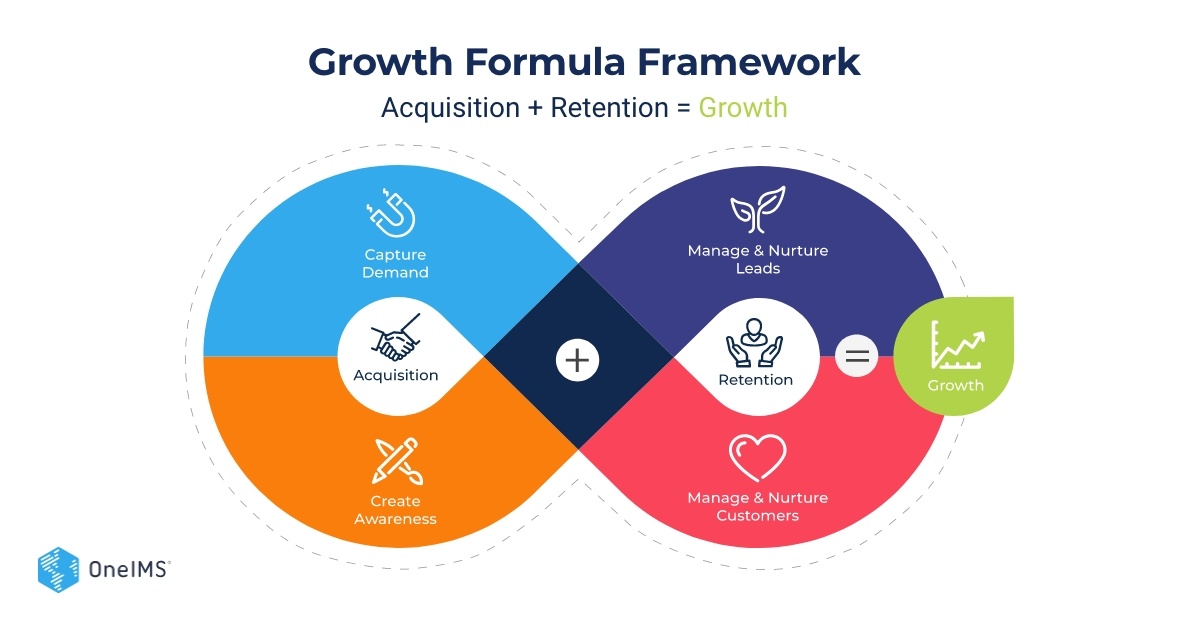
In the growth formula, intent signals play a critical role. They are the connective tissue between your audience’s hidden interests and your team’s ability to act on them.
Create Awareness
Early intent signals, such as engagement with thought leadership, industry content consumption, or social interactions, show how the 97% of your total market that is not actively buying is otherwise learning and forming opinions. Spotting these signals means you can educate buyers about the problem, the solution, and your organization so they can make informed decisions.
Capture Demand
Stronger signals—like product page visits, demo requests, pricing guide downloads, or vendor comparisons—highlight when prospects move into the 3% of in-market buyers. These signals ensure you are found at the right place at the right time, giving you an advantage when buyers are evaluating solutions.
Manage & Nurture Leads
Even among those prospects who engage, most are not ready to purchase immediately. Since a majority of website visitors don’t take action and many leads stall without nurturing, intent signals help you track behaviors and segment prospects. With this insight, you can design omnichannel campaigns that deliver relevant, valuable content and move leads closer to conversion.
Manage & Nurture Customers
Intent signals also apply post-sale. Monitoring product usage, support interactions, or content engagement helps identify upsell, cross-sell, and renewal opportunities. By nurturing customers with personalized campaigns and delighting them at every stage, you can reduce churn and build long-term brand advocates.
Conclusion
Intent signals represent a fundamental shift in how B2B companies understand and engage buyers. The organizations that learn to capture, interpret, and act on these signals will consistently outperform those still relying on guesswork.
If you’re ready to move from reactive to proactive marketing, start by integrating intent data into your strategy today. The earlier you begin, the sooner you’ll uncover hidden opportunities, shorten your sales cycle, and build stronger relationships with the right accounts.
At OneIMS, we can help your company collect, interpret, and use buyer intent signals to their fullest extent. With our growth formula framework, enterprise AI technology, proven marketing strategies, and industry-leading expertise, we’re ready to help you target the right accounts, engage them with precision, and accelerate growth.
Schedule a consultation today to start turning data into decisions and intent into revenue.
.png?width=352&name=01%20_%20OneIMS%20Blue%20_%20Buying%20Signals%20(1).png)