
Table Of Contents
- Why owned content alone cannot carry AI visibility, and why the right owned-to-earned mix changes depending on which engine you are trying to win.
- The three gap types behind most B2B visibility drops, and a diagnostic to find out which one is yours.
- The directory lever: when a directory or marketplace page is cited, brand mention rate runs 60.2% versus 36.3% when one is not.
- The source families that correlate negatively with being named, including one the conventional advice tells you to chase.
- A sequenced 90-day GEO program built on the MAPS Framework, with the four metrics that actually track movement.
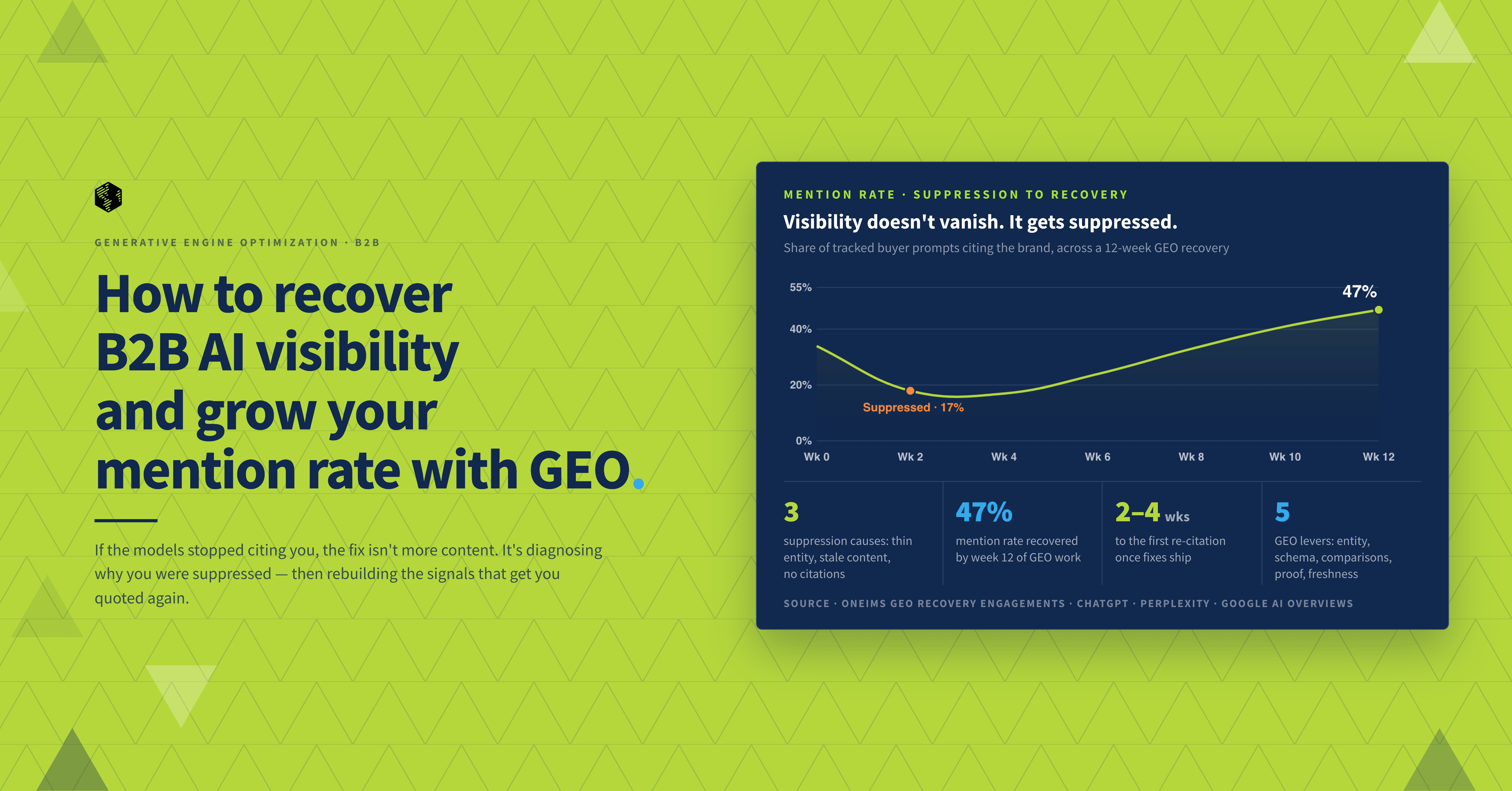
If your brand used to appear in AI-generated answers and now it does not, you are not imagining the drop. AI visibility for B2B companies is actively shifting, and the brands losing ground share a common problem: they optimized for the old signals while the new ones quietly took over.
This guide breaks down why AI visibility drops, what three gap types are responsible for most of the decline, and the specific program sequence that moves B2B brands toward consistent citation across ChatGPT, Perplexity, and Google AI Mode.
What is GEO? Generative Engine Optimization is the practice of building the content, entity signals, and third-party authority network that cause AI answer engines to cite and recommend a brand. It differs from SEO in what it optimizes: SEO competes for a ranked position on a results page, while GEO competes to be one of the sources an engine assembles its answer from. A page can rank first on Google and never appear in a ChatGPT answer, because the two systems weigh different evidence.
Why Does AI Visibility Drop?
Most B2B marketing leaders assume a visibility drop means their content quality declined. That assumption leads them to publish more blog posts, refresh old pages, and chase backlinks. None of those fixes address the actual problem.
AI engines do not rank pages. They assemble answers from a network of sources, and the composition of that network is different from what Google rewards. The practical consequence is that your AI visibility is shaped substantially by what other sites say about you, not only by what your own site says.
OneIMS data on this is direct. In our survey of B2B manufacturers and industrial companies, only 4% said their brand frequently appears in AI-generated answers. Another 41% appear occasionally, 22% rarely or never, and 33% had never checked at all. Put the last two together and 55% of B2B brands either have no meaningful AI visibility or no idea where they stand. Meanwhile 43% named improving AI search visibility a top priority within six months.
How Do AI Engines Select Their Sources?
When a buyer asks an engine which vendors to consider in your category, it is not crawling your site in real time. It is drawing on its index and weighting sources along three lines:
- Source family. Whether a citation comes from a brand website, a directory or marketplace, an editorial publication, or a community forum.
- Entity recognition. Whether there are enough consistent signals across the web for the engine to understand what your brand is and which category it belongs in.
- Citation density. How often your brand name appears alongside the right topics, buyer problems, and industry terms across third-party sources.
Which Source Families Actually Get Brands Named?
Being cited and being named are not the same thing. An engine can cite a page about your category and never mention you. An independent study of 22,295 AI answers and 115,843 citations across 460 B2B prompts measured the difference in brand mention rate depending on which source family the answer drew from.
Read this as correlation, not causation. The study measures which answers named a brand alongside which sources they cited. It does not prove that adding a directory profile causes a mention. Treat the direction as a prioritization signal, not a guarantee.
Two findings here deserve attention because they cut against the standard playbook.
First, directory and marketplace citations carry the strongest positive association, at 60.2% mention rate when one is cited versus 36.3% when none is. That roughly 24-point spread is the single largest lever in the data, and it sits in a channel most B2B content teams treat as administrative housekeeping rather than a visibility investment.
Second, the list and comparison family trends slightly negative, at -4.1 points. This matters because "publish more comparison content" is advice you will hear constantly. The likely explanation is that when an engine leans on a third-party roundup, it tends to report that roundup's picks, and most roundups are not about you. Publishing your own comparison page is still worth doing, since it gives the engine your framing to draw from, but treat it as a coverage fix rather than as the lever that moves your mention rate.
Does the Strategy Change by Engine?
Substantially, yes. The same study found the brand-owned share of citations swings by more than 30 points across engines, which means a single content strategy will underperform on at least one of them. Select an engine to see its profile.
Your own site does most of the work. ChatGPT is the engine where answer-ready service pages, specification detail, and FAQ structure pay off most directly. It also cites fewer sources per answer, so the competition for each slot is tighter. If you can only fix one thing for ChatGPT, make your core pages extractable: direct answer first, question-phrased headings, nothing important locked behind a form.
Roughly two-thirds of the citation surface is outside your control, so owned-content work alone will not move you. This is where directory profiles, review platforms, and earned editorial placement do the heavy lifting. Perplexity also cites more sources per answer, which means more slots available and a genuine opportunity for brands that have built third-party presence.
The profile is close to Perplexity: third-party sources dominate. Because Google AI Mode cites a source in nearly every answer, there is little chance of winning a mention without appearing somewhere in its source set. Technical crawlability and schema matter more here than on the others, since this is the engine most tied to a conventional index.
The practical takeaway is that owned content is necessary but not sufficient. A brand that invests only in its own site may do reasonably well on ChatGPT and stay close to invisible on the other two. A brand that invests only in PR and directories has the reverse problem. The programs that work run both, in a deliberate order.
What Are the Three Gap Types Behind Most Visibility Drops?
Before building a recovery plan, you need to know which gap is actually costing you visibility. Most B2B brands have some of all three, but they differ sharply in urgency and in how long they take to fix.
| Gap type | Root cause | Fix required | Timeline |
|---|---|---|---|
| Coverage | Missing content on the questions buyers ask | New answer-ready content | 4 to 8 weeks |
| Quality | Content exists but AI cannot extract it | Restructuring plus schema | 2 to 4 weeks |
| Authority | Weak third-party signals | PR, directories, editorial | 60 to 90 days |
Check every statement below that describes your situation today. The diagnostic will rank your three gaps and name the one to work on first.
Which gap is costing you the most?
Nine statements, three per gap type. Nothing is submitted or stored.
Your widest gap determines where the next 30 days should go. If two gaps tie, fix the faster one first so you have movement to report while the slower one compounds.
Coverage Gaps
Coverage gaps occur when buyers ask engines questions your content simply does not answer. The engine has nothing of yours to cite because you never produced it. This is the most straightforward gap to diagnose: run 10 to 15 prompts across the three engines using category questions, comparison questions, and problem questions, then document for each answer whether you were mentioned, which competitors appeared, and which sources were cited.
Coverage gaps require new content built specifically around the buyer questions where you are absent. Not general blog posts. Answer-ready pages that lead with a direct response and are structured so an engine can lift a clean, self-contained answer out of them.
Quality Gaps
Quality gaps are more common and more damaging than most teams realize. The content exists, but it is structured so that engines cannot cleanly extract and cite it. As our AEO guide explains, engines respond to content that leads with a direct answer, uses question-phrased headings, and organizes information into self-contained sections. Content buried in long narrative paragraphs, locked behind forms, or filed under vague headings is effectively invisible to retrieval.
Given that ChatGPT draws 68.8% of its citations from brand-owned pages, a quality gap is not a minor formatting issue. It is the difference between being the source on the engine most of your buyers are using and being absent from it.
Authority Gaps
Authority gaps are the hardest to close and the most commonly overlooked. The content exists, it is well structured, but the brand lacks the external credibility signals that cause engines to trust and cite it. Third-party authority is the foundation of AI visibility. Content nobody links to, a brand on no review platforms, and a leadership team with no external mentions all produce the same outcome: no corroborating evidence to support a citation.
This is also where the directory finding earns its place in the plan. Of the five source families measured, directories and marketplaces showed the strongest positive association with being named, and a complete, accurate, actively maintained profile is among the few authority moves a team can finish in a week rather than a quarter.
Not sure which gap is actually yours?
The AI Visibility Audit runs your prompt panel across all three engines and maps which gap type is costing you the most visibility, with the competitor displacement data behind it.
How Does GEO Fit the MAPS Framework?
GEO is not a separate discipline bolted onto your marketing. It is the execution layer of a framework OneIMS runs across every AI visibility engagement. The MAPS Framework sequences the work so that each stage makes the next one effective, which is why the 90-day program below starts with measurement and entity clarity rather than content production.
The OneIMS MAPS Framework · Model buyer intent, Answer clearly, Prove and place, Structure and stay fresh
| MAPS stage | What it does | Gap type it closes |
|---|---|---|
| M: Model buyer intent | Maps the real prompts each buying role uses, which becomes your tracked prompt panel | Coverage |
| A: Answer clearly | Publishes the specifics as extractable, machine-readable content | Quality |
| P: Prove and place | Earns the third-party consensus engines corroborate against | Authority |
| S: Structure and stay fresh | Keeps entity data consistent and core pages current | All three, over time |
The sequence matters more than the speed. Brands that jump straight to content production without fixing entity clarity or directory presence often see minimal lift, because the engines lack the context to understand what the new content is about or who published it.
What Does a 90-Day GEO Program Look Like?
Unlike a one-time content project, GEO runs as a continuous program with a defined sequence. Step through the three phases below.
Month 1: Build the Baseline Before You Build Anything Else
The first 30 days are not about publishing. They are about the foundation that makes everything else measurable.
Measurement first. Build a tracked prompt panel of 20 to 30 specific prompts across category, comparison, and problem query types. Run them across all three engines. Record your baseline mention rate per engine, which competitors appear, and which sources are cited. This panel is your scorecard for the next 90 days, and without it you cannot distinguish a working program from a busy one.
Entity clarity second. AI visibility depends on clear brand positioning. Before publishing a single new page, audit how your brand is described across every public touchpoint: homepage, service pages, your company page on professional networks, directory listings, executive bios, and partner pages. Inconsistent category labels and outdated boilerplate all weaken an engine's ability to categorize you.
Rewrite your core brand description around five specific associations: your category, your audience, the buyer problems you solve, your areas of expertise, and your proof points. Then deploy that exact language everywhere.
Month 2: Close the Commercial Gaps and Claim Your Directory Surface
Month two is execution. Two tracks run in parallel, because one is slow-compounding and the other is nearly immediate.
Commercial content priorities:
- A comparison page addressing how your approach differs from the alternatives buyers are evaluating, including where you are not the right fit
- A service-specific FAQ page with 6 to 10 buyer-phrased questions, each answered directly in 40 to 60 words before any elaboration
- Service pages rewritten with question-phrased H2 headings and answer-first opening paragraphs
- FAQPage and Organization schema deployed across priority pages
Directory and review platform priorities:
- Complete, accurate profiles on the major review platforms in your category, with correct service categories and industry specializations
- A steady review request process, since a profile with no recent reviews is a weak signal
- Submissions to the category-specific directories your industry actually uses
- Your professional network company page updated to carry the same entity language as your owned pages
Given the 24-point spread associated with directory citations, the second track is frequently the higher-return half of this month, and it is almost always the half that gets deferred.
Month 3: Build the External Citation Network
The third phase builds the authority layer that sustains visibility beyond your owned channels. Media mentions, guest articles, podcast appearances, and analyst citations create the cross-source pattern engines use to validate expertise.
- Two to three targeted media or editorial placements in publications your buyers actually read
- Executive thought leadership on the two or three topics you intend to own, published consistently rather than in bursts
- Partner page development with technology partners and industry associations
- Customer case studies structured as answer-ready pages with specific, citable outcomes
The compounding effect: each authority signal reinforces the others. A media mention links back to your site. Your site references your case studies. Your directory profile corroborates both. Over 90 days, that network gives engines the consistent, cross-source evidence they need to name you with confidence rather than hedge.
What Should You Measure?
AI visibility is measurable, but most teams track the wrong things. Page views and keyword rankings do not tell you whether your brand is being named in AI answers. These four metrics do.
For each prompt in your panel, record whether your brand was named. Aggregate across prompts and engines for your overall rate. This is the primary metric and the most direct indicator of progress.
Which families are driving your mentions: brand site, directories, editorial, or community? A healthy profile spans at least three. Over-reliance on owned pages leaves you exposed on the two engines where owned content is roughly a third of the surface.
Track mention rate separately for shortlist-building prompts and research prompts. Visibility on informational queries with absence on commercial ones produces near-zero pipeline impact regardless of your headline number.
For every prompt where you are absent, record who appeared instead. This is your displacement data, and it converts a vague visibility problem into a named target list for each content and authority investment.
Reporting cadence: run the full panel monthly and track direction of movement rather than absolute numbers. Visibility tends to shift slowly at first and then accelerate as the authority network compounds, so a flat month two is not evidence of a failing program. One caution worth setting with stakeholders early: engine answers vary between runs even with identical prompts, so treat a single run as a sample, not a reading. Movement across a panel of 20 to 30 prompts is signal. Movement on one prompt is noise.
Start With a Clear Picture of Where You Stand
The brands that recover AI visibility fastest are not the ones that publish the most content. They are the ones that diagnose accurately before they act. Knowing whether you have a coverage gap, a quality gap, or an authority gap determines which channels to prioritize, which content to build, and where third-party investment will return the most.
The AI Visibility Audit from OneIMS gives you that baseline. In the audit we run your tracked prompt panel across ChatGPT, Perplexity, and Google AI Mode, identify your current mention rate by engine and prompt type, map which gap types are costing you the most, analyze the source families driving competitor mentions on your prompts, and deliver a prioritized action plan sequenced for 90 days.
Find out which gap is displacing you, and who is taking your place
You will leave the audit knowing exactly where you stand by engine, which competitors are being recommended to your buyers instead of you, and what the highest-leverage path forward looks like for your category.
Book My AI Visibility AuditTracked prompt panel · All three engines · Prioritized 90-day plan
Frequently Asked Questions
What is GEO and how is it different from SEO?
Generative Engine Optimization is the practice of building the content, entity signals, and third-party authority that cause AI answer engines to cite and recommend a brand. SEO competes for a ranked position on a results page. GEO competes to be one of the sources an engine assembles its answer from. The two overlap in technical hygiene but diverge in what they reward, which is why a page can rank well on Google and never appear in an AI answer.
Why did my brand stop appearing in AI answers?
Usually one of three gaps. A coverage gap means you have no content answering the questions buyers are asking. A quality gap means the content exists but is structured so engines cannot extract it. An authority gap means you lack the third-party signals engines corroborate against. Diagnose which one you have before publishing anything new, because the fixes and the timelines are different.
How long does it take to recover AI visibility?
It depends on the gap. Quality gaps are the fastest, typically 2 to 4 weeks of restructuring and schema work. Coverage gaps take 4 to 8 weeks to produce and index new answer-ready content. Authority gaps run 60 to 90 days because earned placements and review accumulation cannot be rushed. Most structured programs see meaningful movement in the second half of a 90-day cycle rather than the first.
Do directory listings really affect AI visibility?
The association is the strongest in the data. In a study of 22,295 AI answers, answers that cited a directory or marketplace page named the focal brand 60.2% of the time, against 36.3% when no such source was cited. That is roughly a 24-point spread. Treat it as correlation rather than proof of causation, but as prioritization signals go, it is the clearest one available and the work is cheap relative to earned media.
Which AI engine should B2B companies prioritize?
Prioritize by where your buyers are, then adjust tactics by engine. ChatGPT draws 68.8% of its citations from brand-owned pages, so owned-content quality dominates there. Perplexity and Google AI Mode draw roughly 35% to 38% from brand-owned pages, so third-party authority dominates on those. A program built only for one will underperform on the others.
How do I measure AI visibility?
Build a tracked panel of 20 to 30 prompts across category, comparison, and problem types, run it monthly across all three engines, and record four things: your prompt-level mention rate, the source families driving your mentions, your performance on commercial versus informational prompts, and which competitors appear where you are absent. Engine answers vary between runs, so judge movement across the panel rather than on any single prompt.
Is publishing more comparison content a good way to grow mention rate?
It is worth doing, but not for the reason usually given. In the source-family data, the lists and comparisons family correlated slightly negatively with brand mentions, at -4.1 points. The likely reason is that when an engine leans on a third-party roundup, it reports that roundup's picks. Publishing your own comparison page gives the engine your framing to draw from, which closes a coverage gap. It is not the lever that moves your overall mention rate.
Sources. First-party survey data on B2B manufacturer AI visibility is from OneIMS, The Invisible Brand: How to Start Showing Up in AI Results. Citation source-family and engine-level figures are from an independent study of 22,295 AI answers and 115,843 citations across 460 B2B prompts and 37 organizations, published August 2026: source family mix and source family effect on brand mention rate.
.png?width=352&name=manufacturing-w-blog-title%20(1).png)
.png?width=352&name=01%20_%20Deep%20Navy%20_%20ChatGPT%20shortlist%20mockup%20(1).png)