
Table Of Contents
Many B2B companies are trying to improve AI visibility by publishing more content, updating old blogs, chasing backlinks, or looking for quick technical fixes.
Those efforts can help, but they may not solve the real issue. In many cases, the actual problem is that the brand is not clearly defined.
AI systems need to understand who your company is, what category you belong in, who you serve, what problems you solve, and what topics your brand should be associated with. If your public presence sends mixed signals, AI tools have a harder time connecting your company to the right questions.
This type of positioning now plays a bigger role in visibility. Your brand needs to become easier to understand, easier to categorize, and easier to connect to the problems your buyers care about.
Before a B2B brand can become more visible in AI search, it needs a clearer answer to one question: What should we be known for?
-May-08-2026-06-38-44-1136-PM.png?width=1920&height=1005&name=HubSpot%20Content%20Hub%20for%20Marketers%20(2)-May-08-2026-06-38-44-1136-PM.png)
AI Cannot Recommend What It Cannot Understand
AI cannot confidently recommend a brand it does not clearly understand.
A company may have a strong website, experienced leadership, a capable team, and real client results, but if its broader digital footprint is vague or inconsistent, AI systems may struggle to understand where the brand fits.
The issue usually shows up as a pattern problem. Your content may mention too many disconnected services. Your service pages may speak to several different audiences without a clear priority. Your thought leadership may cover industry trends without consistently tying them back to the problems your company solves.
None of that means the content is bad. It means the signals are scattered.
AI systems look for repeated associations. They need to connect your brand name to specific topics, services, buyer problems, industries, people, and proof points. If those connections are weak or inconsistent, the system has less confidence in how to summarize or recommend your company.
Here is where positioning becomes part of AI visibility. A brand that tries to be known for everything often becomes known for nothing specific.
-May-08-2026-06-38-44-2844-PM.png?width=1920&height=1005&name=HubSpot%20Content%20Hub%20for%20Marketers%20(3)-May-08-2026-06-38-44-2844-PM.png)
Generic Positioning Creates Generic Visibility
Many B2B brands describe themselves in language that feels safe, polished, and professional but does not create a strong association. You’ve probably seen phrases like these:
- “We help businesses grow.”
- “We provide end-to-end solutions.”
- “We are a trusted partner.”
- “We deliver customized strategies.”
- “We help companies scale.”
- “We offer innovative solutions for modern businesses.”
These statements may be true. The problem is that they’re too broad to be useful.
Generic positioning doesn’t clarify category, audience, problem, expertise, or differentiation, which makes the brand harder for buyers and AI systems to place. In other words, if your positioning could apply to hundreds of other companies, it doesn’t give AI systems or buyers a strong reason to connect your brand to a specific need.
Your brand can offer multiple services, serve multiple industries, and solve multiple problems. But the market and AI systems still need to understand the strongest association you want to build.
Why AI Search Makes Positioning More Important
Traditional search often rewarded page-level relevance. If a page was well optimized, technically sound, linked properly, and useful enough, it could rank for a target query even if the broader brand was not especially well understood.
AI search changes the standard. AI systems pull from many pieces of information to create a synthesized response. They may consider your website, third-party mentions, public profiles, reviews, articles, podcasts, partner listings, executive bios, and other signals that help them understand your brand.
That means the brand itself becomes part of the answer.
-May-08-2026-06-38-44-1116-PM.png?width=1920&height=1005&name=HubSpot%20Content%20Hub%20for%20Marketers%20(4)-May-08-2026-06-38-44-1116-PM.png)
AI tools are trying to connect multiple pieces of information:
- What is this company called?
- What does it do?
- What category does it belong in?
- Who does it serve?
- What problems does it solve?
- What topics is it repeatedly associated with?
- Who is connected to the company?
- What external evidence supports its authority?
- Is the information consistent across sources?
Strong positioning gives AI systems a clearer structure for interpreting your brand. Weak positioning forces them to infer too much from scattered information.
AI systems favor clarity because clarity reduces uncertainty. A company with repeated, consistent signals around a specific audience, category, problem, and area of expertise is easier to interpret than a company with disconnected messaging across the web.
As a result, positioning is becoming part of how companies are discovered, summarized, and recommended.
The Real Risk: Being Visible But Not Defined
Some companies are excellent at online visibility. They have content, they rank for certain keywords, they appear in directories, they post on LinkedIn, their leadership team shows up in interviews or podcasts, and they may even have press mentions.
But visibility without definition is weak.
A brand can show up in many places and still fail to create a clear identity. That happens when every touchpoint tells a slightly different story.
For example, consider a manufacturing company that wants to be known for custom packaging equipment:
- The website describes the company as a custom machinery manufacturer.
- Product pages focus on filling systems, conveyors, capping machines, and labeling equipment.
- Case studies highlight food and beverage applications.
- Directory listings describe the company more broadly as an industrial equipment supplier.
- Leadership content discusses manufacturing innovation in general but rarely connects back to packaging automation, production efficiency, or line integration.
None of those signals are necessarily wrong. But together, they don’t create a clear pattern.
AI systems may see a company connected to machinery, manufacturing, equipment, automation, food production, and industrial services yet still lack a strong enough association with the specific category the company wants to own.
And if your brand signals are unclear, your company may be visible online but not defined enough to be recommended.
-May-08-2026-06-38-44-1646-PM.png?width=1920&height=1005&name=HubSpot%20Content%20Hub%20for%20Marketers%20(5)-May-08-2026-06-38-44-1646-PM.png)
The 5 Associations Every B2B Brand Needs to Define
Before chasing more content, more PR, or more visibility, B2B leaders need to define the associations they want their brand to own. A simple way to think about this process is by answering five core questions.
1. Category: What Market Should We Be Placed in?
Your category gives buyers and AI systems a starting point. It tells them where to place your company mentally.
Are you a project management platform, a workflow automation tool, a customer onboarding solution, a revenue intelligence platform, a vertical SaaS product, or an AI-powered operations platform?
You may touch several of these areas, but you still need a primary category anchor. Without one, your brand becomes harder to classify.
One of the biggest mistakes B2B companies make is avoiding category clarity because they don’t want to narrow their market. So they describe themselves as, for example, an “all-in-one platform,” “business productivity solution,” “AI-powered software,” or “operating system for growth.” The intention makes sense, but the result is usually weaker positioning.
A SaaS company can support multiple use cases, departments, and workflows, but there still needs to be a clear center of gravity. That center of gravity helps buyers decide whether you belong on their shortlist. It also helps AI systems place your brand in the right context.
-May-08-2026-06-38-44-2335-PM.png?width=1920&height=1005&name=HubSpot%20Content%20Hub%20for%20Marketers%20(6)-May-08-2026-06-38-44-2335-PM.png)
Think about the difference between these two descriptions:
- “We help teams work smarter with an all-in-one platform.”
- “We help customer success teams reduce onboarding delays by automating handoffs, tracking implementation milestones, and giving managers clearer visibility into account progress.”
The second description gives the brand a category, audience, problem space, and set of capabilities. It gives buyers more context and AI systems more useful associations.
2. Audience: Who Do We Serve Best?
B2B positioning gets stronger when it is tied to a specific audience.
“Businesses” is too broad. “Manufacturers” is stronger. “Mid-sized manufacturers trying to improve operational efficiency” is even clearer. “Food and beverage manufacturers struggling with production bottlenecks, quality issues, and rising labor costs” is sharper still.
You don’t need to exclude every other buyer, but you do need to clarify who your expertise is built around. A defined audience helps your content, examples, case studies, and thought leadership feel more specific. It also helps AI systems understand when your brand is relevant to a buyer’s situation.
When the audience is unclear, the rest of the message gets weaker. Strong audience clarity gives the entire brand position more weight.
3. Problem: What Buyer Problem Do We Solve?
AI visibility is often shaped by buyer questions, and those questions are usually problem driven. For a plastic extrusion manufacturer, for example, buyers ask things like:
- How do we find a plastic extrusion manufacturer for custom profiles?
- How do we reduce defects in extruded plastic parts?
- How do we choose the right material for a custom plastic extrusion?
- How do we lower tooling costs for a new plastic profile?
- How do we improve consistency across high volume extrusion runs?
- How do we replace a metal or rubber component with an extruded plastic profile?
- How do we find a manufacturer that can handle complex plastic profile designs?
If your brand wants to appear in those answers, your messaging and content need to repeatedly connect your company to those problems.
This is where many B2B companies fall short. Their messaging names what they sell, but not the pain behind it. For example, “custom plastic extrusion” is a service, but the buyer problem might be inconsistent part quality, long lead times, material selection challenges, high tooling costs, tight tolerance requirements, or difficulty finding a supplier that can turn a concept into a manufacturable profile. The more clearly you connect your brand to the problems buyers care about, the stronger your visibility foundation becomes.
AI systems respond to context. A brand that repeatedly discusses a buyer problem with depth, specificity, and proof becomes easier to associate with that problem.
4. Expertise: What Topics Should Be Associated with Us?
A strong B2B brand needs a focused topic map.
For an accounting firm, topic associations might include business tax planning, bookkeeping accuracy, cash flow visibility, financial reporting, payroll compliance, multi-state tax filing, outsourced accounting, CFO advisory, audit preparation, and year-end tax strategy. The point is to identify the topics that reinforce the firm’s desired market position.
Many firms create content calendars by asking, “What should we post about this month?” A stronger question is, “What do we need to become known for?”
That shift changes the entire content strategy. Instead of producing disconnected articles, newsletters, and social posts, your team starts building a body of work around a few strategic themes.
For B2B companies, strong topic ownership usually sits at the intersection of:
- What your buyers urgently care about
- What your company can credibly speak about
- What supports your commercial goals
- What differentiates your approach
- What you can produce consistently
Consistency is what turns a topic into an association. If you want to be known for tax planning, then your public footprint should show clear expertise around entity structure, deductions, estimated taxes, multi-state compliance, year-end planning, succession planning, and cash flow impact.
Random content creates random associations. Focused content creates memory.
5. Proof: What Evidence Supports the Association?
Positioning cannot live on claims alone. If you want your brand to be known for a category, problem, or area of expertise, buyers need evidence. AI systems need evidence too.
That proof can include case studies, client outcomes, reviews, founder expertise, partner validation, certifications, original research, detailed service examples, media mentions, and customer stories.
It also has to be specific and connected to the position you want to own.
A vague claim says, “We help teams plan better events.”
A stronger proof point says, “We help event teams manage registrations, automate attendee communication, coordinate vendors, track event tasks, and measure post-event engagement from one platform.”
One is broad. The other creates a clearer association.
The key is alignment. Proof should reinforce the position you want to own. If you want to be known for helping organizations run smoother events with fewer manual steps, then your proof should show improvements in registration completion, attendee check-in speed, email follow-up, vendor coordination, task visibility, event reporting, and post-event engagement.
Strategic proof helps connect your expertise to reality. AI systems and buyers both need that connection.
How to Make Your Brand Easier for AI to Understand
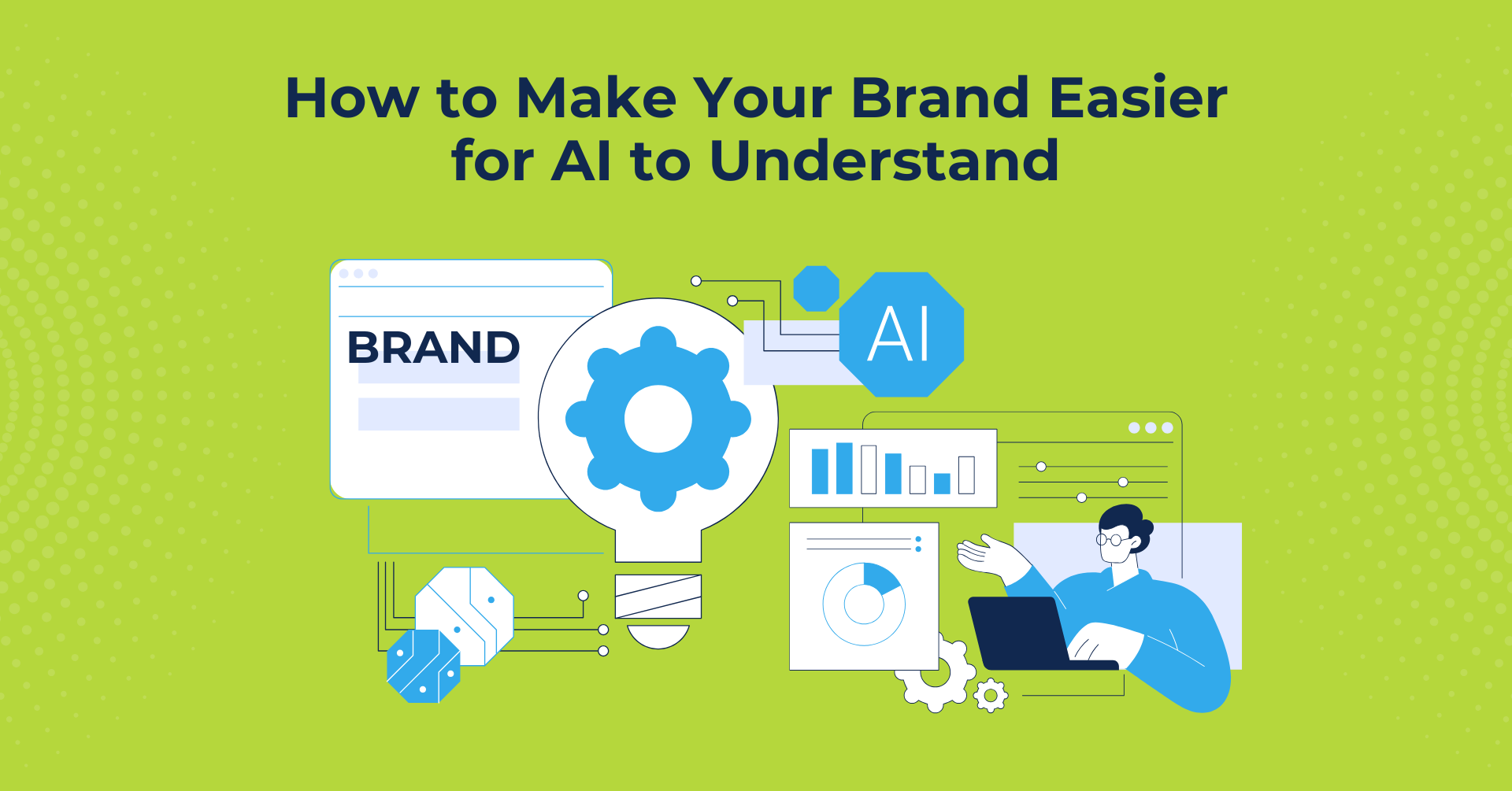
Improving AI visibility begins with making the brand easier to interpret, which often starts with cleaning up the signals you already control.
Start with your public footprint. Look at your homepage, service pages, about page, executive bios, LinkedIn company page, founder profiles, partner pages, directory listings, podcast bios, webinar descriptions, case studies, marketplace profiles, and sales materials.
Ask a simple question: Would someone reviewing all of this content understand the same brand story?
If the answer is no, you have work to do.
Here is a practical process.
Audit How Your Brand Is Described Across the Web
Collect your company descriptions from the places where buyers and AI systems may encounter you. Look for outdated language, inconsistent category labels, vague service descriptions, and profiles that do not reflect your current positioning.
You may be surprised by how many versions of your company exist online.
Choose 2–3 Topics You Want to Own
Don’t try to be known for everything at once. Pick the areas that matter most to your growth strategy.
These topics should connect your business goals to buyer problems. They should also reflect real expertise your team can support through content, examples, client work, and thought leadership.
Rewrite Core Messaging Around the 5 Associations
Clarify your category, audience, buyer problem, expertise, and proof. Make them the foundation for your company boilerplate, service page language, executive bios, media profiles, sales materials, and thought leadership.
You don’t want to write the same exact words over and over again, but make every touchpoint point in the same strategic direction.
Align Leadership & Subject Matter Expert Visibility
In many B2B companies, leaders and experts carry much of the trust. Their bios, LinkedIn content, podcast topics, bylined articles, and speaking descriptions should support the company’s desired position. If the organization wants to be known for one thing and leadership is publicly known for something unrelated, the signal weakens.
Build Content Around Buyer Problems
Service pages are important, but buyer questions matter too. Create content that addresses the problems your audience is actively trying to solve.
For example, instead of only writing about “industrial manufacturing services,” create content around how to reduce production bottlenecks, how to improve equipment uptime, how to choose the right manufacturing partner, how to lower defect rates, or how to make custom parts more cost effective at scale.
This approach gives AI systems more context around when your brand is relevant.
Connect Proof Points to Priority Topics
Don’t let case studies, reviews, and customer outcomes sit disconnected from your positioning. Organize them around the topics and problems you want to own.
A case study becomes more powerful when it reinforces a specific association. Similarly, a review becomes more useful when it mentions the problem solved, and a customer story becomes more valuable when it supports the category you want to lead.
Recheck AI Tools Regularly
Ask AI tools the kinds of questions your buyers might ask.
Look at whether your brand appears, how it’s described, what competitors show up, which sources are referenced, and whether the answer reflects your desired positioning.
AI tools vary, and responses will change. But this exercise can reveal whether the market is beginning to understand your brand the way you intend.
FAQs About AI Visibility
Conclusion
AI visibility favors the brands that are easiest to understand, verify, and associate with the right problems.
When your website, content, leadership profiles, case studies, partner pages, media mentions, and external profiles all reinforce the same core associations, your brand becomes easier to understand. Buyers understand you faster, sales conversations become sharper, content becomes more focused, and AI systems have a clearer pattern to recognize.
Before you ask why AI is not mentioning your brand, ask whether your brand has given AI a clear enough story to repeat.
At OneIMS, we help B2B companies build the strategy, content, and visibility systems needed to compete in AI-driven search. From AEO and GEO to demand generation and brand visibility, our team helps your company show up where modern buyers are already looking for answers.
Schedule a consultation today to learn how to strengthen your brand’s AI visibility.
.png?width=352&name=01%20_%20Deep%20Navy%20_%20ChatGPT%20shortlist%20mockup%20(1).png)
.png?width=352&name=manufacturing-w-blog-title%20(1).png)