
Table Of Contents
To optimize existing B2B content for AI search engines, you need to restructure each page so it answers specific questions directly, uses clear heading hierarchies, and presents information in self-contained sections that AI engines can extract and cite without additional context. This is different from traditional SEO. You are not just optimizing for a crawler reading metadata; you are writing for a language model deciding whether your page is the most credible, specific answer to a user's query.
This guide gives you a practical, page-level checklist to work through your existing content systematically. It covers both SEO fundamentals and AEO (Answer Engine Optimization) signals so your pages perform in Google Search and in AI-generated answers from tools like ChatGPT, Perplexity, and Google AI Overviews.
Who this is for: Marketing leaders, content managers, and revenue-focused executives at B2B manufacturers, industrial companies, and mid-market tech firms who have existing content and want to make it work harder without starting from scratch.
- You do not need to start over. In most cases, existing B2B content can be restructured and enriched to satisfy both search crawlers and AI engines.
- Self-contained sections are the single most important AEO principle. AI engines extract individual sections, not entire pages.
- Vague content does not get cited. Replacing broad generalizations with concrete detail signals expertise to readers and engines alike.
- Ten page-level checks cover it, from a direct answer in the first paragraph through to technical fundamentals.
- Prioritization beats completeness. Start with high-traffic pages that have weak AEO signals, then bottom-of-funnel pages.
Why AI Search Changes the Content Optimization Game
Traditional SEO optimized for ranking signals: backlinks, keyword density, page speed, and structured metadata. Those signals still matter. But AI search engines layer something new on top: they read your content the way a researcher would, evaluating whether your page actually answers the question, whether the answer is clear and specific, and whether the source appears authoritative.
When a B2B buyer asks ChatGPT "what is the best approach for industrial lead generation" or asks Google "how do manufacturers improve their sales pipeline," the AI engine does not return a ranked list of blue links. It synthesizes an answer and cites the sources it drew from. If your content is vague, poorly structured, or buried under jargon, it will not be cited, regardless of your domain authority.
The Core Difference Between SEO and AEO
Use the controls below to view either discipline on its own, or both side by side.
| Dimension | Traditional SEO | AEO (Answer Engine Optimization) |
|---|---|---|
| Primary audience | Search crawler | Language model plus human reader |
| Key signal | Backlinks, keyword match | Direct, specific answers |
| Content structure | Keyword-rich paragraphs | Self-contained, question-answering sections |
| Success metric | Ranking position | Citation in AI-generated answer |
| Content length bias | Longer tends to rank | Concise, precise answers win |
The good news: you do not need to delete what you have built. In most cases, existing B2B content can be restructured and enriched to satisfy both audiences. That is exactly what the checklist below is designed to help you do.
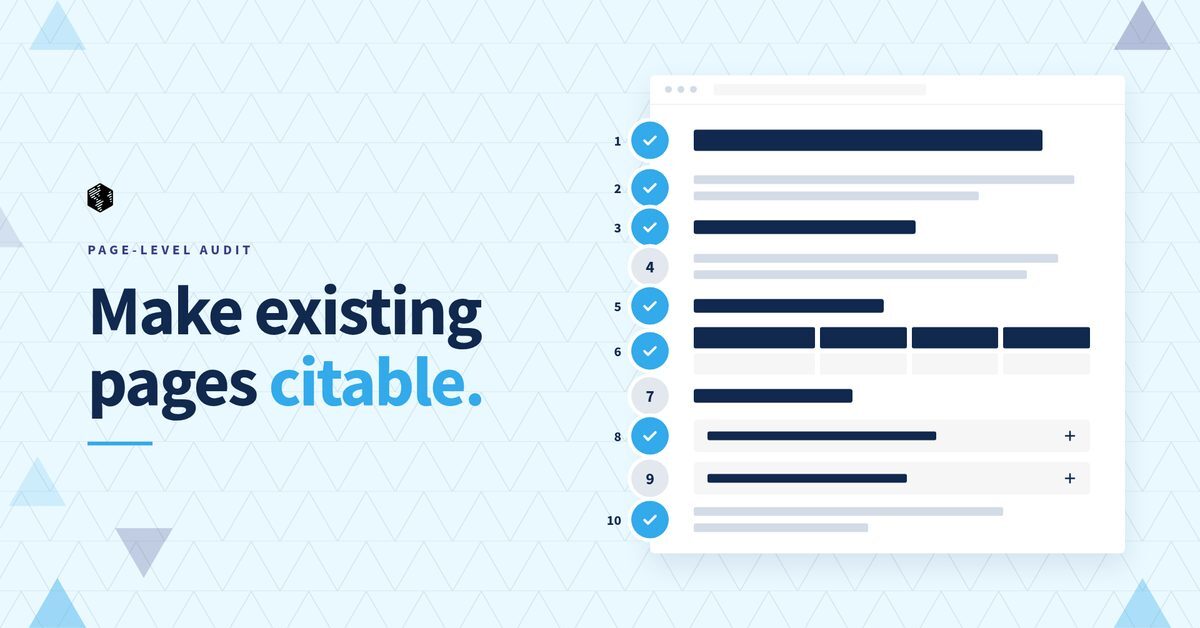
The Page-Level Checklist: How to Optimize B2B Content for AI Search Engines
Work through this checklist one page at a time. Prioritize your highest-traffic pages and any pages targeting bottom-of-funnel queries first, since those are the searches most likely to drive revenue.
Open the page you want to optimize in another tab. Tick each check once that page passes it. Every item links to the section that explains it.
Checked 0 of 10. Readiness: Early.
This score is your own read of one page, not a measurement. Nothing is submitted or stored, and the count resets when you reload. Run it page by page to decide where the work goes.
1. Start with a Direct Answer in the First Paragraph
AI engines look for what is called an "answer passage": a short, self-contained response to the implied question of the page. If your page targets the query "how does industrial automation reduce operational costs," the first paragraph should answer that question directly, in plain language, without preamble.
- Does the first 50 to 75 words of the page answer the primary question?
- Is the answer written in plain language, free of industry jargon?
- Can the opening paragraph stand alone as a useful response if quoted in isolation?
If your current introduction spends three paragraphs setting context before getting to the point, restructure it. Put the answer first, then provide the supporting context.
2. Audit Your Heading Structure
Headings are how AI engines navigate your content. Each H2 and H3 should function as a question or a clear topic signal, not just a label.
- Are your H2 headings phrased as questions or as specific topic statements? ("How to Reduce Lead Time in Industrial Supply Chains" performs better than "Lead Time Overview")
- Does each section under a heading directly address that heading's implied question?
- Is there a logical hierarchy: H1 (page title), then H2 (major sections), then H3 (subsections within those)?
Avoid heading stacks where an H2 is immediately followed by another H2 with no body content between them. Every heading should introduce at least a paragraph of substance.
3. Make Every Section Self-Contained
This is the single most important AEO principle. AI engines extract individual sections, not entire pages. If a section references "the approach described above" or "as we mentioned earlier," it loses extractability. Each section should make sense on its own.
- Does each H2 section introduce its own context without relying on earlier sections?
- Are key terms defined within the section, not just in the introduction?
- Would a reader who landed directly on this section (via a deep link or AI citation) understand the point being made?
4. Add or Strengthen FAQ Content
In our view, FAQs are a strong format for AI citations because each question and answer pair can be extracted on its own. If your page does not have an FAQ section, add one. If it does, audit the quality of the answers.
- Are questions phrased the way your buyers actually ask them, not the way your internal team talks about the topic?
- Is each answer 40 to 100 words: long enough to be complete, short enough to be extractable?
- Do the questions address the next logical thing a reader would want to know after reading the page?
5. Improve Specificity Throughout
Vague content does not get cited. AI engines favor pages that make specific, verifiable claims over pages that use broad generalizations. This does not mean inventing data; it means replacing vague language with concrete details.
- Replace phrases like "many manufacturers" with "manufacturers in high-mix, low-volume production environments."
- Replace "significant improvement" with the actual mechanism: "by reducing handoff steps between sales and operations."
- Replace "we help companies grow" with "we build demand generation programs for B2B manufacturers targeting mid-market industrial buyers."
Specificity also signals expertise. The more precisely you describe a problem or a solution, the more credible the page appears to both human readers and AI engines.
6. Add Structured Data Where Appropriate
Structured data (schema markup) helps AI engines understand what type of content a page contains and how to categorize it. For B2B content, the most relevant schema types are:
- Article or BlogPosting for editorial content
- FAQPage for pages with question-and-answer sections
- HowTo for step-by-step guides
- Product or Service for pages describing your offerings
If you use HubSpot CMS, schema can be added via custom modules or through HubSpot's built-in structured data tools. Confirm that your FAQ sections are marked up with FAQPage schema so they are eligible for rich results in Google Search.
7. Strengthen Internal Linking with Descriptive Anchor Text
Internal links help AI engines understand the relationship between your pages. Generic anchor text like "click here" or "learn more" provides no context. Descriptive anchor text tells the engine exactly what the linked page covers.
- Does each internal link use anchor text that describes the destination page's topic?
- Are your most important service or solution pages linked from relevant blog and resource content?
- Are there orphaned pages (no internal links pointing to them) that should be connected to the broader content structure?
8. Review Metadata for Clarity and Keyword Alignment
Meta titles and descriptions are not just ranking signals; they are the first thing a human reader sees in a search result. They also inform how AI engines categorize and describe your page.
- Does the meta title include the primary keyword in natural language?
- Is the meta description written as a direct, useful summary of the page, not a marketing tagline?
- Is the meta title under 60 characters and the meta description under 160 characters?
9. Assess Page Authority Signals
AI engines give more weight to pages that appear authoritative. Authority is built through a combination of backlinks, author credibility signals, and content depth.
- Is there an author byline with a link to a bio page that establishes credentials?
- Does the page link out to credible external sources where relevant?
- Has the page been updated recently? A "last updated" date signals that the content is current.
10. Confirm Technical Fundamentals Are in Place
AEO cannot compensate for broken technical foundations. Before optimizing for AI citations, confirm the basics are solid.
- Page loads in under three seconds on mobile and desktop
- No broken internal or external links
- Canonical tags are set correctly (no duplicate content issues)
- The page is indexed and not blocked by robots.txt or noindex tags
- Images have descriptive alt text
How to Prioritize Which Pages to Optimize First
Running this checklist across an entire content library is a significant undertaking. Prioritize strategically rather than working through your sitemap in alphabetical order.
Start with pages that have the highest potential return:
- High-traffic pages with weak AEO signals. Pages already getting organic traffic but structured as traditional SEO content. These are your fastest wins because the authority is already there; you just need to restructure the content.
- Bottom-of-funnel pages. Solution pages, comparison pages, and "how it works" content that buyers consult before making a decision. These are the queries where AI citations drive the most direct revenue impact.
- Pages targeting question-based queries. Any page whose target keyword starts with "how," "what," "why," or "which" is a natural AEO candidate. These map directly to how buyers query AI tools.
- Your pillar pages and topic clusters. If you have a content cluster structure, start with the pillar page. Optimizing the pillar creates a strong center of gravity that benefits the surrounding cluster pages.
If you use HubSpot, your traffic analytics and HubSpot's SEO tools can help you identify which pages are already ranking and which have the most room to improve. Layer in Google Search Console data to find pages with high impressions but low click-through rates, a reliable signal that the page is visible but not compelling enough to earn the click.
Frequently Asked Questions
What is the difference between SEO and AEO for B2B content?
SEO (Search Engine Optimization) focuses on improving a page's ranking in traditional search results through signals like backlinks, keyword relevance, and technical performance. AEO (Answer Engine Optimization) focuses on making content extractable and citable by AI-powered tools like ChatGPT, Perplexity, and Google AI Overviews. In practice, the two approaches overlap significantly: well-structured, specific, authoritative content performs well in both environments. The main AEO-specific additions are self-contained sections, direct answer passages, FAQ schema markup, and question-phrased headings.
Do I need to rewrite my existing content from scratch?
In most cases, no. The majority of existing B2B content can be optimized through restructuring rather than full rewrites. The most impactful changes are typically: adding a direct answer in the first paragraph, rewriting headings to be more specific and question-oriented, breaking long sections into self-contained subsections, and adding or improving an FAQ section. A full rewrite is only warranted if the content is fundamentally off-topic for its target query or is written in a way that cannot be restructured without losing coherence.
How long does it take to see results from AEO optimization?
In our view, AI engine citation patterns may change faster than traditional search rankings, likely because AI engines re-evaluate content more often. That said, building authority and citation visibility is a cumulative process. Structural changes to individual pages can show results within weeks in some cases, while broader authority signals (backlinks, author credibility, content depth) build over months. The most reliable approach is to treat AEO as an ongoing content quality standard rather than a one-time project.
Does page length matter for AI search optimization?
For AI citations specifically, conciseness and precision matter more than length. A 600-word page with a clear direct answer, well-structured sections, and an FAQ will typically outperform a 3,000-word page that buries its key points in dense paragraphs. That said, longer content is not a disadvantage if it is well-organized. The goal is to make every section of a page independently valuable, regardless of total length.
What types of B2B content benefit most from AEO optimization?
The content types that benefit most are those targeting question-based or comparison queries: "how to" guides, "what is" explainers, solution comparison pages, and industry-specific FAQ content. For B2B manufacturers and industrial companies, this often includes content around product specifications, process explanations, compliance requirements, and buyer decision criteria. These are the queries where your buyers are already using AI tools to research before engaging a sales team.
Should I use AI tools to write my AEO-optimized content?
AI writing tools can accelerate the drafting process, but they require careful human oversight for B2B content. AI-generated content tends toward vague generalizations, which is the opposite of what AEO requires. If you use AI tools in your content workflow, treat the output as a first draft that needs to be enriched with specific details, industry-relevant examples, and your organization's actual expertise. The content that gets cited by AI engines is content that demonstrates genuine knowledge, not content that merely sounds like it does.
Ready to Make Your B2B Content Work Harder?
Optimizing existing content for AI search engines is one of the highest-leverage investments a B2B marketing team can make right now. The content you have already built represents significant time and budget. Restructuring it to meet AI citation standards extends its value without starting from zero.
The challenge for most marketing leaders is not knowing what to do; it is having the capacity and expertise to do it systematically across an entire content library while also running campaigns, supporting sales, and managing everything else on the roadmap.
That is where we come in. OneIMS works with B2B manufacturers, industrial companies, and mid-market technology firms to audit, optimize, and build content programs that perform in both traditional search and AI-generated answers.
Answer 32 questions and we'll send you a personalized report. It is a diagnostic that shows the gaps in your strategy, infrastructure, and visibility.
Get My Score