
Table Of Contents
This week, a lot of B2B teams are pausing to say thank you: to customers who renewed, to partners who referred, to colleagues who showed up. That instinct is also a visibility strategy. The people who vouch for you publicly are your strongest asset to get mentioned in AI answers.
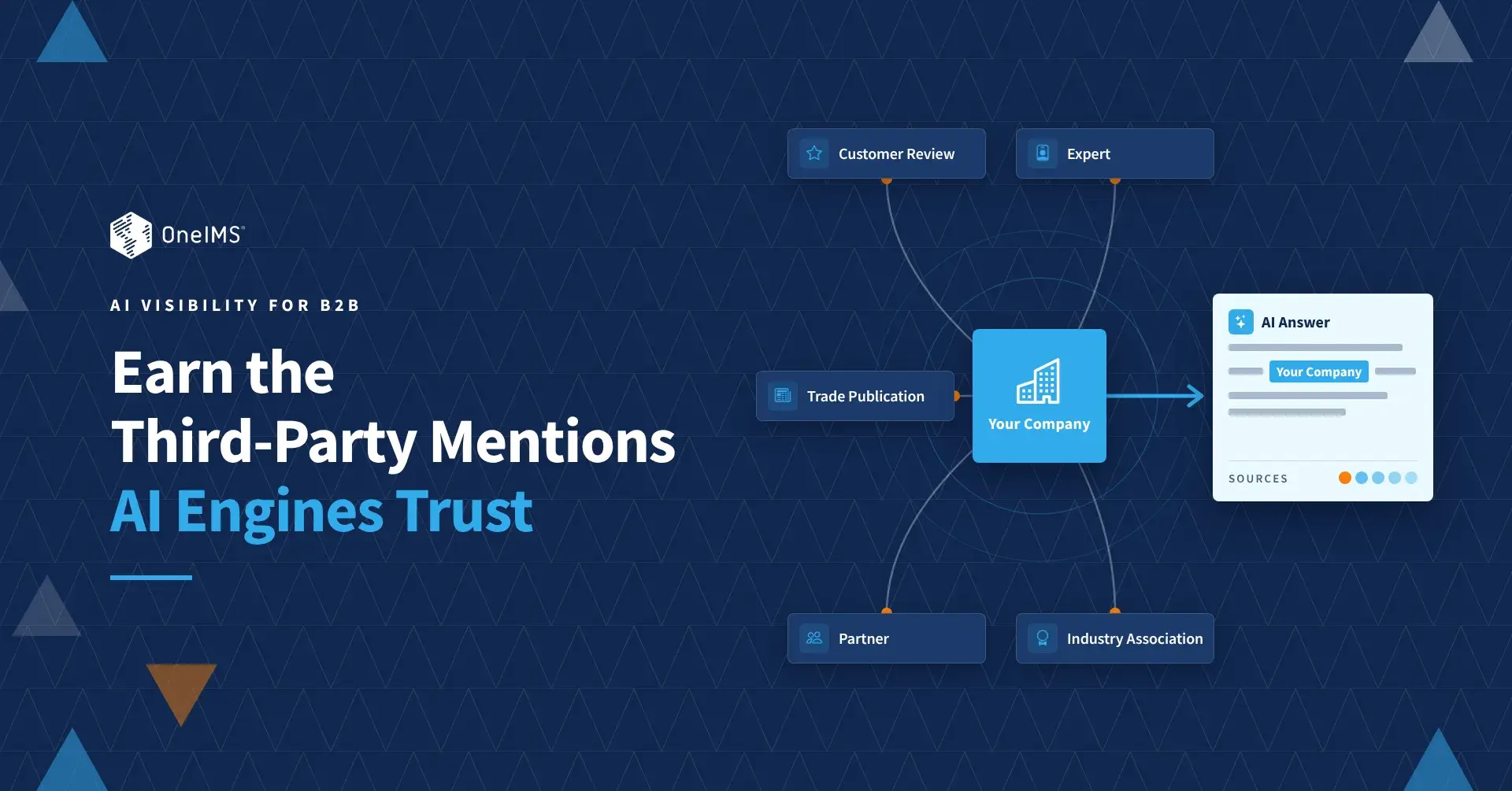
When ChatGPT, Perplexity, or Google AI Mode decides whether to recommend your company, it does not take your homepage at its word. It looks for independent corroboration: third-party sources that describe what you do, who you serve, and what results you produce. The more consistently those sources agree, the more confidently an AI engine names you.
The brands that earn third-party mentions are not always the ones with the best content. They are the ones other people talk about accurately and specifically.
Most B2B manufacturers, industrial companies, and SaaS firms already have the raw material: satisfied customers, industry partners, and subject-matter experts with real points of view. What they lack is a system for turning those relationships into citable, AI-retrievable evidence.
This article covers what makes third-party mentions trustworthy, which sources to pursue first by industry, what evidence to hand every publication or directory, how to measure mention-rate movement, and why the most effective version of this program starts with genuine gratitude rather than a PR brief.
Six Terms That B2B Teams Confuse (and Why the Difference Matters)
These six terms get used interchangeably, but they describe different things and carry different weight with AI engines.
Brand mention
- What it is
- A third party names your company in any context
- What it does for AI visibility
- Creates citation density: your name associated with a topic or category
AI citation
- What it is
- An AI answer links to or attributes a specific page
- What it does for AI visibility
- Signals that a source was used to construct the answer; does not always include a brand mention
Third-party validation
- What it is
- An independent source corroborates your category, capabilities, or results
- What it does for AI visibility
- The strongest trust signal; engines weight this over self-reported claims
Backlink
- What it is
- Another site links to yours
- What it does for AI visibility
- Useful for domain authority but not equivalent to independent validation
Review
- What it is
- A customer describes their experience on a platform with editorial standards
- What it does for AI visibility
- Combines third-party validation with social proof; heavily cited by AI engines in vendor-evaluation queries
Entity consistency
- What it is
- Your company name, category, industry, and proof points are described the same way across sources
- What it does for AI visibility
- Reduces ambiguity; helps engines categorize and confidently recommend you
| Term | What it is | What it does for AI visibility |
|---|---|---|
| Brand mention | A third party names your company in any context | Creates citation density: your name associated with a topic or category |
| AI citation | An AI answer links to or attributes a specific page | Signals that a source was used to construct the answer; does not always include a brand mention |
| Third-party validation | An independent source corroborates your category, capabilities, or results | The strongest trust signal; engines weight this over self-reported claims |
| Backlink | Another site links to yours | Useful for domain authority but not equivalent to independent validation |
| Review | A customer describes their experience on a platform with editorial standards | Combines third-party validation with social proof; heavily cited by AI engines in vendor-evaluation queries |
| Entity consistency | Your company name, category, industry, and proof points are described the same way across sources | Reduces ambiguity; helps engines categorize and confidently recommend you |
A brand can accumulate hundreds of backlinks and still be invisible in AI answers if those sources do not describe the company clearly. The goal is not volume. The goal is corroborated specificity.
For a fuller explanation of why a mention and a citation are different wins, see how AI assistants decide which B2B companies to recommend. Entity consistency is the most commonly overlooked of the six: if public sources disagree on your category or proof points, engines have less confidence recommending you. For how to choose that language, see why AI visibility depends on clear brand positioning.
Why AI Engines Trust Third Parties More Than They Trust You
Short answer: AI engines are trained to recognize that first-party marketing content is inherently biased. They weight independent sources because those sources have no incentive to overstate your capabilities.
In our survey of B2B manufacturers and industrial companies, only 4% said their brand frequently appears in AI-generated answers, and 55% either have no meaningful AI visibility or have never checked where they stand. Source-family research helps explain the gap: engines look past what you say about yourself.
In the source-family research we break down in our GEO mention-rate guide, brand mention rate was 60.2% when an answer cited a directory or marketplace page, versus 36.3% when it did not. That is correlation, not proof that a new listing causes a mention, but it is a clear prioritization signal.
The clearest single signal in the source-family research. This is an association, not a causal result.
| Condition | Brand mention rate |
|---|---|
| Directory or marketplace page cited | 60.2% |
| No directory or marketplace source cited | 36.3% |
Source: the source-family research covered in our GEO mention-rate guide.
The Source-Priority Scorecard: Where to Earn Mentions First
Not every third-party mention is worth the same effort. Score each potential source on a 1 to 5 scale against these five criteria, then prioritize the highest totals.
The Five Scoring Criteria
- Buyer relevance (1-5): Do your target buyers use this source during vendor research? A trade publication they read weekly scores a 5. A general directory they have never heard of scores a 1.
- Editorial independence (1-5): Does the source have selection standards, named authors, or a review process? Unreviewed paid submissions score a 1. Fact-checked reporting scores a 5.
- Entity clarity (1-5): Can the source include a description specific enough to establish your category, specialization, and customer type? A name-and-phone listing scores a 1. A profile with services, industries, certifications, and outcomes scores a 5.
- Evidence depth (1-5): Can it include reviews, customer outcomes, case studies, certifications, or expert commentary? A bare listing scores a 1. Verified reviews and customer-attributed results score a 5.
- AI retrieval likelihood (1-5): Does this source already appear in AI-answer citation sets for your category? If engines already pull from it for your industry's queries, it scores a 5.
Score each criterion from 1 to 5, then compare totals across the sources you are considering. The article's own rule is to prioritize the highest totals.
How Source Priorities Differ by Industry
The same source type does not carry equal weight across industries:
| Source type | Manufacturers | Industrial firms | B2B SaaS |
|---|---|---|---|
| Leading manufacturing and industrial trade publications | 5 | 5 | 2 |
| Industrial supplier and distributor directories | 5 | 4 | 1 |
| Technical associations and certification bodies | 4 | 5 | 2 |
| Software review platforms | 1 | 2 | 5 |
| Software and CRM app marketplaces (including the HubSpot App Marketplace) | 1 | 1 | 5 |
| Cloud and technology partner directories | 2 | 2 | 5 |
| Industry analyst and research firm references | 3 | 3 | 5 |
| Conference speaker pages and event programs | 4 | 4 | 4 |
| Customer case studies published by the customer or a partner | 5 | 5 | 5 |
| Agency and professional-services review directories | 3 | 2 | 4 |
| Trade association member directories | 4 | 5 | 2 |
| LinkedIn company page and employee thought leadership | 4 | 4 | 4 |
The universal high-scorers are customer case studies and conference or association appearances. A case study published by the customer, on their own domain, with named outcomes and a named expert combines editorial independence, entity clarity, evidence depth, and buyer relevance in one document. No press release, directory listing, or review-platform profile matches it.
Trade publications, partner pages, and expert commentary are also high-value sources. For the earned-media system behind those placements, see how PR helps B2B brands get cited in AI answers. For a broader view of how AI engines measure authority across these source types, see the OneIMS AEO guide.
What Makes a Mention Citable: The 7-Item Evidence Kit
Short answer: A mention is only as useful as the information it contains. Vague mentions do not help AI engines categorize you. Specific, verifiable, consistently phrased mentions do.
Hand every publication, directory, partner, or review platform the same seven-item kit:
- A category-specific company description (50-75 words). Not "we help companies grow." Something like: "We provide demand generation, SEO, and HubSpot implementation for B2B manufacturers and industrial companies with sales cycles longer than 60 days." Include your category, audience, and the buyer problem you solve.
- The industries you serve, stated precisely. "Manufacturing" is too broad. "Precision machining, contract electronics assembly, and industrial automation" is citable. More specific language means more queries you can appear in.
- A verifiable customer outcome. One real result with scope, timeframe, and methodology. As a hypothetical illustration, a result such as "increased qualified pipeline by 40% over 12 months" is the level of specificity that is citable. "We drive results for manufacturers" is not. Use only approved, attributable outcomes in live submissions.
- A named subject-matter expert with a point of view. A person with a title, a stated area of expertise, and a publicly accessible bio. Named-author authority is now a load-bearing AI retrieval signal. For how to make those experts visible and citable, see why subject-matter experts are your biggest untapped AEO asset.
- A customer or partner who can independently corroborate the outcome. A customer who has published their own version of the same result on their own domain is worth more than any press release.
- A canonical URL for the relevant service or industry page. Give the source a specific page to link to, not just your homepage, so the mention connects cleanly to your entity.
- Consistent terminology. Use the same category labels, industry terms, and service names across every submission. Inconsistency is one of the most common reasons engines fail to connect mentions to the right brand.
Keep this kit in a shared document and update it quarterly. The consistency discipline is as important as the content.
Strong, Useful, Weak, and Risky: How to Grade Any Mention Before You Pursue It
Before committing time or budget, grade any potential source on this four-tier system.
Strong:A trade publication quotes your lead engineer on how industrial buyers are using AI to evaluate suppliers, names your company and category, links to your capabilities page, and the article is retrievable by AI engines.
Editorial independence, named expertise, specific context, and a retrievable URL.
Useful:A complete review-platform profile with recent customer reviews, accurate service categories, industry specializations, and a customer outcome in the reviewer's own words.
Less authoritative than a feature article, but consistent, verifiable, and often cited in vendor-evaluation queries.
Weak:A mass-submitted press release with generic boilerplate, no independent editorial context, and no named author.
These create noise but rarely produce citable corroboration.
Risky:A paid "top agencies" list with no disclosed methodology, inaccurate descriptions, and no editorial accountability.
These can harm entity clarity if they contradict your other sources.
Before and After: The Weak Listing vs. the Upgraded Listing
The difference between a weak listing and a strong one is usually not the platform. It is the information you provide.
"B2B Company is a Midwest-based manufacturer offering custom metal fabrication and machining services."
"B2B Company is a precision metal fabrication manufacturer specializing in tight-tolerance components for medical device, aerospace, and industrial equipment OEMs. Work is scoped to a defined category, audience, and [named customer outcome], with the same terminology used across every public profile."
The upgraded version gives an AI engine a category ("precision metal fabrication"), an audience ("medical device, aerospace, and industrial equipment OEMs"), and a specific proof point ("[named customer outcome]"). The weak version gives it a city and a list of services. One of those descriptions helps an engine name you with confidence. The other gets you indexed and forgotten.
The Gratitude Loop: Turning Genuine Thanks Into Proof
The most effective earned-mention programs start with genuine appreciation for the relationships that already exist, then convert that appreciation into publicly visible evidence.
This is not about being transactional. The customers, partners, and colleagues who have already invested in your relationship are the most credible sources you have. Asking them to share their experience is not an imposition when you have delivered value. It is an invitation to tell a true story.
Genuine relationships produce genuine corroboration, which earns the next round of thanks.
Four Gratitude-to-Proof Moves
1. Thank customers, then ask for reviews and case studies. After a successful milestone or renewal, send a personal note of thanks before any ask. Then, separately, invite them to share their experience on the review platform most relevant to their industry. For case studies, offer to draft the narrative and let them edit. A customer-published case study on their own domain, with a specific outcome and their name attached, is the strongest third-party asset you can produce.
2. Credit partners and update partner pages. When a technology or implementation partner contributes to a client result, say so publicly, and ask them to do the same. A mutual partner page that describes the relationship, the industries served, and the outcomes produced is a high-value, independently corroborated entity signal.
3. Spotlight subject-matter experts. Nominate your engineers, strategists, and technical leads for conference speaking slots, and pitch them as sources to trade publications on topics they genuinely know. An expert cited across multiple publications creates a cross-source pattern engines use to validate your expertise claims. For the full process of making those experts AI-citable, see why subject-matter experts are your biggest untapped AEO asset.
4. Recognize industry associations and trade media. Respond to editorial calls for commentary, contribute to association working groups, and sponsor relevant industry research. These relationships are far easier to build before you need a mention than after. For a system to earn those editorial and partner placements, see how PR helps B2B brands get cited in AI answers.
Genuine relationships produce genuine corroboration. Manufactured mentions, undisclosed paid placements, and generic press releases produce noise. AI engines are increasingly good at telling the difference.
Where This Fits in the MAPS Framework
This playbook is the Prove & Place stage of the MAPS Framework: earning independent corroboration and placing it where AI engines already look. Model Buyer Intent tells you which industry terms those mentions should use, Answer Clearly makes sure owned pages can be cited alongside them, and Structure & Stay Fresh keeps the descriptions consistent after they are live.

For the technical side of entity markup, see our guide to schema markup for AI search. For the full service engagement, see the OneIMS AEO and GEO services overview.
How to Measure Progress and a 90-Day Earned-Mention Plan
Short answer: The right metric is brand mention rate across a tracked prompt panel, not backlink count or press coverage volume. Track movement monthly, not weekly.
Metrics That Reflect Real Progress
- Prompt-level mention rate: For each prompt in your tracked panel, record whether your brand was named. This is the primary indicator.
- Source family breakdown: Which source types are driving your mentions? A healthy profile draws from at least three families: owned pages, directories or review platforms, and editorial or association sources.
- Competitor displacement data: For every prompt where you are absent, record who appeared instead. This turns a vague visibility problem into a specific target list.
For competitive share of voice, and for how to build and run the prompt panel, use the method in our AI share of voice guide.
90-Day Earned-Mention Plan: Operating Targets
These are operating targets, not performance guarantees. Plan for most measurable movement in the second half of the 90-day window.
Audit all existing third-party profiles for accuracy and consistency
Operating target100% of priority profiles updated with evidence-kit language
Set a mention-rate baseline using the prompt panel method in our AI share of voice guide
Operating targetBaseline mention rate established per engine
Submit or upgrade listings on top-scoring directory and review sources
Operating target5-8 priority profiles completed
Initiate customer review requests on highest-scoring platforms
Operating target3-5 new verified reviews published
Start SME and trade-publication outreach using the process in our PR & AEO post and SME AEO post
Operating targetOutreach underway on 2-3 opportunities
Update partner pages with co-authored outcome language
Operating target2-3 mutual partner pages live
Commission or co-publish 1 customer case study
Operating target1 case study live on customer or partner domain
Rerun the prompt panel and compare to baseline
Operating targetDirection of mention rate movement established
Treat the 90-day window as long enough to see directional movement, not long enough to declare a program a success or a failure. Plan for the work to compound over two to three cycles as the cross-source pattern strengthens. For a realistic stage-by-stage view, see our AEO timeline for B2B.
Frequently Asked Questions
Why do AI engines trust third-party mentions more than owned content?
First-party marketing content is biased toward the brand that published it. Independent sources have no commercial incentive to overstate your capabilities, so they carry more weight as corroborating evidence.
Do backlinks still matter for AI visibility?
They contribute to domain authority, but backlinks alone do not produce AI mentions. A complete, accurate profile on a platform engines actively cite is more useful than a link from a source that describes you vaguely.
Which review platforms matter most for manufacturers and industrial companies?
In manufacturing and industrial queries, AI engines tend to draw more from industry-specific directories, leading manufacturing trade publications, and trade association member listings than from general software review platforms.
How many third-party sources do I need before I see a lift in AI mentions?
There is no fixed number. What matters is a consistent mix, not a longer list of thin listings. For most B2B teams, that mix is a complete profile on the one or two directories or review platforms engines already cite in your category, plus at least one independently published customer or partner proof point, plus one editorial or association mention that uses the same category language. A stack of twenty vague listings is weaker than five specific, consistent ones. For the separate question of how many editorial placements help a named expert get cited, see our guide to getting subject-matter experts online.
Can a negative review hurt my AI visibility?
A single negative review on an otherwise strong profile is unlikely to suppress mentions. A pattern of negative reviews, or reviews that describe your company differently from your other sources, can create conflicting entity signals and reduce an engine's confidence in recommending you.
Should manufacturers prioritize directories or trade publications first?
Directories first, because they are faster to complete and show the clearest association with mention rate in the data we've cited. Trade publications produce stronger authority signals but take more lead time. Run both tracks in parallel once the directory work is underway.
What is entity consistency and why does it matter?
It means your company name, category, industries served, and proof points are described the same way across directories, review platforms, partner pages, and editorial mentions. If those sources disagree, engines have less confidence recommending you. Audit existing descriptions before you add new ones. For how to choose the category and proof language itself, see why AI visibility depends on clear brand positioning.
How do I know if my third-party authority is actually improving?
Track brand mention rate on a fixed prompt panel, then look at which source families appear when you are named. The program is working when mentions rise and a larger share of those mentions is supported by directory, review, or editorial sources rather than only your own site. Use the measurement method in our AI share of voice guide. For how long AEO work usually takes to show up, see our AEO timeline for B2B.
Find Out Where You Stand Before You Build
The fastest path to earning third-party mentions is not publishing more content. It is knowing which gap is holding you back, and closing it in the right order.
This week is a natural time to start. Thank the customers, partners, and peers who already vouch for you, then give them a clear way to do it in public.
If you are a B2B manufacturer, industrial company, or SaaS firm that wants to understand your current mention rate, which engines are citing your competitors instead of you, and what your third-party authority profile looks like today, the OneIMS GrowthScore gives you that baseline in minutes.
It benchmarks your AI visibility, identifies the source gaps most likely to be suppressing your mentions, and gives you a prioritized starting point for the work described in this article.
Run your GrowthScore now at growthscore.oneims.com/system
Get your current mention rate, see which engines are citing competitors instead of you, and a prioritized starting point for the work described in this article.
Run your GrowthScore now